
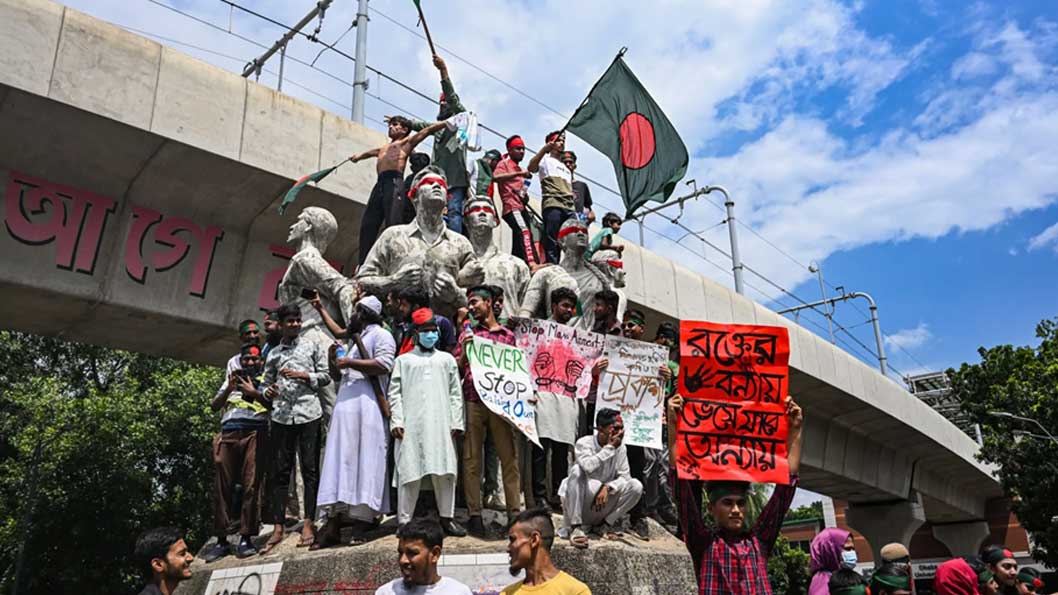
The 2024 uprising brought down an increasingly authoritarian political order. What followed poses a harder question: can political rupture produce democratic transformation?
On 5 August 2024, Sheikh Hasina left Bangladesh after fifteen consecutive years as prime minister. A political order that had appeared increasingly difficult to challenge collapsed within weeks. The immediate trigger had been much narrower: university students protesting against quotas in public-sector employment. But as the government responded with repression and lethal force, students were joined by workers, women, teachers, professionals and people from poorer neighbourhoods. A movement about access to government jobs became a mass uprising against the way political power itself was being exercised.
The United Nations estimated [1] that as many as 1,400 people may have been killed between 1 July and 15 August 2024, with children accounting for an estimated 12–13 per cent of those killed. Its subsequent fact-finding investigation found reasonable grounds to believe that the former government and its security and intelligence apparatus, together with violent elements associated with the ruling Awami League, systematically committed serious human rights violations in an attempt to suppress the protests.
Bangladesh has since returned to electoral politics and embarked on institutional reform. But removing a government poses a different challenge from constructing what comes afterwards. What happens when a movement united around removing an increasingly authoritarian political order must confront the much harder task of constructing a democratic alternative?
From student protest to popular uprising
Calling July 2024 simply a ‘student uprising’ obscures an important part of its history. The movement was initiated and organised by the students, and their role was decisive. But as repression intensified, participation spread far beyond university campuses.
An investigation by Prothom Alo [1], Bangladesh’s most widely read newspaper, examined the backgrounds of 810 people included in the government’s list of those killed. Working-class people constituted 35 per cent of the deaths, compared with 33 per cent who were students. Day labourers, rickshaw pullers, drivers, shop and restaurant employees and garment workers were among those killed. Seventy-nine per cent of the victims investigated were under 35.
Garment workers provide an important window into this wider participation. The Bangladesh Garment Sramik Samhati, a garment workers’ organisation, identified at least 26 garment workers killed during the uprising. Its president, labour activist Taslima Akhter [2], wrote that workers earning just Tk 12,500 a month (approximately EUR 97 at the time) recognised in the student protests their own experiences of deprivation and discrimination. For her, remembering this participation is itself political: ‘The history of the July uprising must also include the struggles and sacrifices of the working class.’
July was student-led, but it became a broader popular uprising. This raises a question that matters beyond Bangladesh: who gets remembered as the author of an uprising, and whose aspirations shape what follows?
Women in the uprising, but not after it?
Nowhere is that question sharper than in the experience of women. Women students played important organisational and leadership roles. On 15 July, women from Dhaka University’s female halls broke through their gates and joined demonstrations after Sheikh Hasina’s remarks [3] comparing protesters to ‘razakars’, a deeply charged term associated with collaborators during Bangladesh’s 1971 Liberation War. Many subsequently faced assault and harassment but continued participating.
What happened afterwards tells a different story. Umama Fatema [4], then spokesperson for the Anti-Discrimination Student Movement, described her experience bluntly: ‘When male leaders were arrested, women stepped up to lead and continued until August 5. But after that, I was completely sidelined.’ Nazifa Jannat [4], another student coordinator, expressed the frustration differently: ‘It is deeply unfortunate that we are now compelled to assert that we, too, were part of the movement.’
The experience extended beyond university students. Sabina Yasmin [4], a female labourer from Ashulia, challenged the description of July as simply a student movement. ‘In reality, labourers, including female workers, participated spontaneously’, she said. Many women were injured or killed, she added, yet their sacrifices remained unrecognised.
These voices raise questions about access to political power after an uprising. In the February 2026 parliamentary election, only seven women were directly elected to the 300 constituency seats. However, this should not be understood simply as a failure of the post-uprising political settlement. Women often stand at the forefront of social movements while remaining marginal within formal political institutions. Political parties, electoral competition and state institutions continue to operate within deeply patriarchal social structures which determines who will be considered a legitimate political leader.
The July uprising created an opening for democratic change, but it did not dissolve these structures. Nor did the broad coalition that challenged the Hasina government necessarily share a common understanding of gender equality or women’s political representation. An uprising can unsettle political power without transforming the social relations through which power is reproduced.
This also reveals one of the internal tensions of broad democratic movements. Feminists, workers, students, artists, Islamists, secularists, liberals, leftists and other constituencies could unite against an increasingly authoritarian political order without sharing a common understanding of gender equality, religious freedom, economic justice or the meaning of citizenship. Political unity against authoritarianism did not necessarily imply ideological agreement on the democratic society that should follow.
Who belongs to ‘the people’?
The experience of religious and Indigenous minorities provides another test of that opening. Violence against religious minorities did not begin with the uprising, but the breakdown of law and order surrounding the fall of the government created particular vulnerability. The United Nations reported [5] that immediately after the fall of the government, on 5 and 6 August 2024, Hindu homes and properties were attacked, vandalised or looted in 27 districts, alongside attacks on places of worship. It also recorded students and other citizens organising locally to protect minority communities and religious sites.
The scale and motivation of subsequent violence remain contested. The Bangladesh Hindu Buddhist Christian Unity Council reported [6] 258 incidents affecting religious minorities during the first six months of 2025, including 27 murders, 59 attacks on places of worship and 87 attacks on homes and businesses. The interim government subsequently cited [7] police records showing 645 minority-related incidents during 2025 but classified only 71 as communal. The disagreement over classification should not obscure the issue underneath it: can citizens belonging to a religious minority participate in public life with the same security and dignity as the majority?
For Bangladesh’s Indigenous peoples, the post-uprising experience raises a similar concern. The Kapaeeng Foundation documented[8] 32 incidents involving violations of civil and political rights affecting 170 Indigenous people between January and July 2025. It also documented land-related incidents and violence against Indigenous women during the same period.
These are not peripheral ‘minority issues’.They also expose a larger problem in the transition from uprising to political order. The people who filled the streets in 2024 did not necessarily share the same understanding of what should replace the system they were challenging. Students demanded reform and accountability; workers brought demands rooted in economic insecurity; women challenged their exclusion; minorities demanded security and equal citizenship. These demands could coexist in opposition to the Hasina government without forming a common political programme for what should follow.
The question is therefore not simply whether a majority can choose its rulers. It is whether those who participated in the uprising can shape the political order that emerges afterwards.
From the street back to parliament
The February 2026 election provides one indication of how this transition has unfolded. The European Union Election Observation Mission described [9] the election as credible and competently managed and, for the first time since 2008, genuinely competitive. It also noted sporadic localised political violence and a persistent fear of mob attacks.
The results show how differently established parties and political forces emerging from an uprising can convert a political opening into parliamentary power. Of the 297 constituency results initially gazetted by the Election Commission, the Bangladesh Nationalist Party (BNP) won 209 seats, Jamaat-e-Islami 68, and the National Citizen Party (NCP), formed by leaders emerging from the 2024 uprising, six.
The BNP, a centre-right party rooted in Bangladeshi nationalism, returned as the dominant governing force, while Jamaat, an Islamist party advocating a stronger role for Islamic principles in public life, became the principal opposition.
The social forces that had filled the streets in 2024 were therefore not the forces best positioned to convert that mobilisation into parliamentary power. Established parties possessed organisational networks, political structures and resources that were difficult for a new movement to replicate in a short period.
This raises a harder question about transformation. If the political forces that inherit the institutions after an uprising are largely established forces, how far can the uprising change the structures that produced the earlier crisis?
The point is not simply whether a movement needs to become a government in order to change politics. It is whether the social forces that challenged the old order have acquired enough political and institutional power to shape what replaces it.
The experience of Bangladesh raises a difficult possibility. A mass movement can remove a government while established political and economic forces retain much of their organisational capacity and influence. The crisis that produced the uprising may therefore be displaced without all the structures behind it being transformed. The question is not only who comes to power after an uprising, but whether the balance of power itself has changed.
Can institutions constrain power?
This is where the July National Charter [10] becomes important. The Charter brought together recommendations from reform commissions initiated by the interim government and areas of political agreement reached through subsequent negotiations. It proposed changes to the electoral and constitutional system, limits on the Prime Minister’s tenure, stronger checks on executive power, greater representation of women and the opposition in Parliament, judicial independence and stronger protection of fundamental rights.
The Charter was followed by a Constitutional Reform Implementation Order and a national referendum held alongside the February 2026 parliamentary election. The ‘Yes’ vote secured a clear majority. But the referendum did not settle how the reforms would be implemented.
The implementation framework envisaged a Constitution Reform Council made up of elected members of parliament. Opposition MPs took the additional oath required for the Council, but BNP lawmakers did not. The Council was therefore never constituted.
Instead, the new government formed a special committee [11] in July 2026 to rediscuss the constitutional reform proposals and to prepare recommendations for constitutional amendments. The opposition rejected this route, arguing that the referendum mandate and the implementation framework required the Constitution Reform Council to be convened.
The disagreement is not a technical matter. It goes to the heart of the transition. Bangladesh has reached agreement, at least in principle, on several ways of reducing the concentration of political power. But agreement on reform is not the same as institutional change.
The question is whether the forces that benefited from the existing political system will accept reforms that place lasting limits on their own power.
The July uprising therefore poses a question beyond replacing one ruling party with another: can the architecture through which power is exercised also change?
From political democracy to economic power
Constitutional reform cannot answer everything. The uprising began, after all, with jobs. Public-sector employment represented economic security and social mobility for many educated Bangladeshis, while the participation of garment workers, day labourers and other poorer citizens revealed a wider experience of economic insecurity.
For a garment worker, democratic transformation may therefore look different. It may mean a dignified wage, freedom to organise, employment security and some influence over decisions affecting working life. Taslima Akhter [4] connects workers’ rights directly to democratic transformation, arguing for dignified living conditions, freedom to speak against injustice and a voice for workers in national policymaking.
This does not diminish electoral democracy. It widens the question. Political democracy asks who can choose the government. A deeper democratic transformation must also ask who exercises power at work, in the economy, within families and across society. If political competition becomes more democratic while economic power remains concentrated, how far has transformation actually travelled?
When the powerful fall: a South Asian question
Bangladesh is not alone in confronting this problem. In 2022, Sri Lanka experienced the Aragalaya [12], the Sinhala word for ‘struggle’. An unprecedented economic crisis brought shortages of fuel, food and medicines, long power cuts and soaring inflation. Protesters occupied public spaces for months, demanding the resignation of President Gotabaya Rajapaksa and challenging a political establishment they held responsible for the collapse. In July, protesters entered the presidential residence; Rajapaksa fled the country and resigned.
His removal did not immediately produce the transformation many protesters had hoped for. Parliament installed Ranil Wickremesinghe as president, while economic stabilisation proceeded under an International Monetary Fund-backed programme. Two years later, Anura Kumara Dissanayake [13] won the presidency on a platform challenging corruption and established political elites. The Aragalaya had not itself become a government, but the discontent it expressed continued to reshape electoral politics.
Nepal followed another trajectory. In September 2025, protests triggered by a government ban [14] on major social-media platforms quickly connected with wider anger over corruption and limited economic opportunities. Prime Minister K.P. Sharma Oli resigned as the political crisis deepened. The upheaval was also highly destructive: later official figures put the death toll at 77 and the number injured above 2,000.
The three movements arose from different political histories. Sri Lanka’s grew from economic collapse. Bangladesh’s began with employment quotas and widened under violent state repression. Nepal’s connected a dispute over social-media restrictions with longstanding anger over corruption and political stagnation. They should not be forced into a single regional narrative.
But they do share an important political lesson. Governments that appear firmly entrenched can become unexpectedly vulnerable when large numbers of people withdraw their consent and mobilise against them. Removing those in power, however, is not the same as changing how power works. Institutions, social hierarchies and economic relations do not disappear when a president or prime minister leaves office. This is where Bangladesh, Sri Lanka and Nepal begin to speak to one another.
What comes after mobilisation?
It may be too early, and perhaps too simple, to ask whether Bangladesh’s July uprising ‘succeeded’ or ‘failed’. It demonstrated the depth of discontent with the existing political order and showed that a government that appeared deeply entrenched could be removed through mass mobilisation. But the more revealing question is what happens to that mobilisation once its immediate objective has been achieved.
The experience so far is mixed. Electoral competition has returned, institutional reforms have been proposed and the July Charter has received public endorsement. At the same time, established political forces have retained much greater organisational power than the groups that emerged from the uprising, while many of the social demands visible in the streets remain contested or unresolved.
Students demanded fairness, workers dignity, women political space and minorities equal citizenship. These demands could unite people against the existing order without necessarily producing agreement about the society that should replace it. The strength of the uprising was its ability to bring people together against an established political order. Its unresolved problem is whether that collective power can become a shared political project.
Bangladesh, Sri Lanka and Nepal have shown, under very different circumstances, the ability of mass mobilisation to unsettle powerful political orders. What remains unresolved is harder and slower: can the power people demonstrate in removing an old political order be translated into a democratic alternative in which power itself is more widely shared?
References
[2] https://thegreatwave.thedailystar.net/news/july-uprising-in-the-lives-of-garment-workers?
[8] https://kapaeengnet.org/indigenous-peoples-human-rights-report-1-january-31-july-2025/
[10] https://www.bssnews.net/news-flash/302440
[11] https://en.prothomalo.com/bangladesh/government/xgb6zgm8tc
Vinod Koshti is a Project Manager at the Rosa-Luxemburg-Stiftung’s South Asia office in New Delhi. His work focuses on political and social developments in South Asia, with particular interests in democratic transformation, social justice, Indigenous peoples’ rights, agrarian relations, and the intersections of climate and gender justice.
Disclosure: Written with AI assistance for research and editing. The arguments, interpretations, and final text remain the responsibility of the author.
Image: Bloomberg