
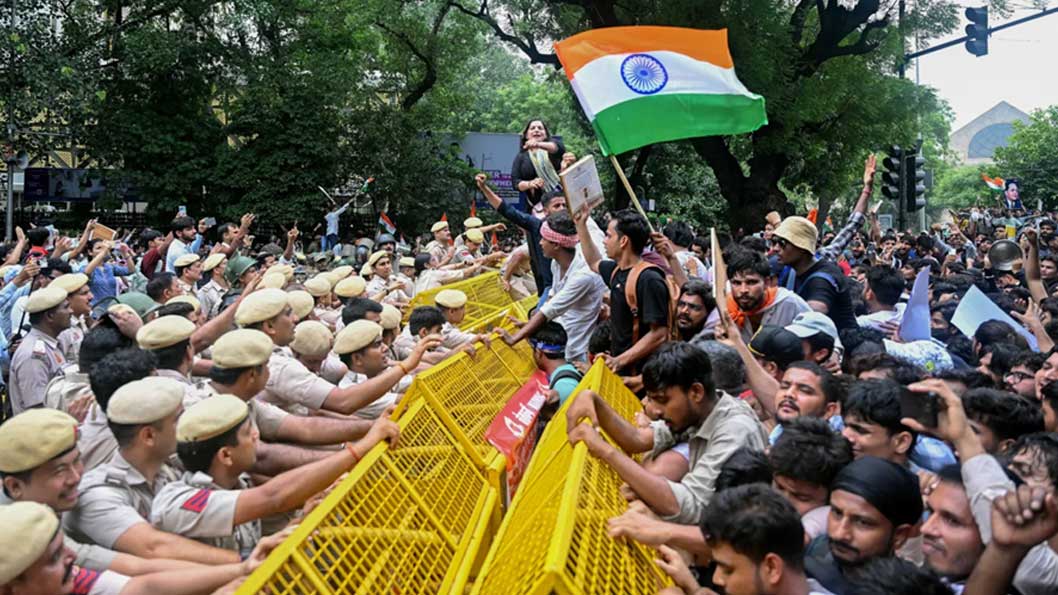
If democracy is to be qualified as one, it cannot, by and large, ban protest. But protest is not simply what democracy allows. It is something people make and remake, deciding themselves how to bargain with those who holds power, when to be restrained and when to be angry. Perhaps what matters, then, is not that protest is allowed, but which kind a democracy can live with, and which it cannot. It opens forth a stage only for the protest it already knows how to hear and absorb.
The recent outbursts of resistance in India tell us that protest is never received in one uniform way. The farmers who held Delhi’s borders for over a year in the midst of COVID pandemic have forced the repeal of three farm laws, and yet more than 700 of them died in the sitting, most of them small or landless, while the state cut the internet around them as they sat.
The women wrestlers who accused the head of their own federation, a sitting member of the ruling party, of sexual harassment, and who, when they tried to walk from Jantar Mantar to the brand new Parliament building, were dragged into police buses and cleared off the road – only turning out the man they accused was acquitted three years later.
The movement against the discriminatory Citizenship Amendment Act (CAA), which challenged a citizenship law that made religious identity central to a new route to citizenship asked perhaps the hardest question of all: who counts as Indian? Its leading student organisers were not met with a concession, but with prosecution under the Unlawful Activities (Prevention) Act (UAPA), India’s anti-terror law, and prolonged imprisonment without trial.
A protest may be dispersed, its leaders jailed or its immediate demand conceded. But the conditions that brought people into public space to dissent do not disappear with the crowd. They remain and also return, sometimes in another place or in another language, sometimes through another group of people.
Hence, the most recent youth uprising, too, belongs to these sporadic public eruptions under the present regime. And it is so not because it repeats earlier movements, but because it emerged from the same political landscape of restricted dissent.
But protest is never only a matter of what is said. It is also shaped by where it can be said, how long it can remain there, and whether it can move closer to the power it addresses. In Delhi, Jantar Mantar has become the most recognisable site for this negotiation between dissent and authority. It is a site where the government allows you to be angry at it, and would like you to notice that it allows it. It occupies a peculiar space in India’s democratic imagination and it is where the recent Cockroach protest began!
The so-called Cockroach Janata Party took its name from a remark by the Chief Justice, who had compared the country’s unemployed youth to cockroaches, and it grew online fast enough to embarrass the ruling party. For over a month, it held Jantar Mantar; the social activist cum educator, Sonam Wangchuk, initiated a hunger strike, the government was cursed by name, and no one moved them yet. Then, on the opening day of the monsoon session, the protesters tried to walk to Parliament, and the barricades, the lathis, and the tear gas arrived, along with the shutdown and the shuttered metro stations.
The protest may have ended with the Education Minister’s resignation, but surveillance and criminalisation continued long after the crowds had dispersed. Students across several states were arrested, while protest footage was processed through facial recognition technology to identify participants.
The protest, in other words, was ‘tolerated’ as long as it remained a public event. Once it was over, it became a database of faces that could be identified and tracked individually.
But to recognise the limits of the state’s tolerance is not to reduce what the movement achieved. If anything, it makes those achievements more historic and politically precious.
The protest brought together people across generations and professions, compelled the resignation of a Union Minister, and reopened the possibility of mass mobilisation at a time when such mobilisation has been rare under the current regime. Just as none of these erases the repression that followed, neither does the repression erase what the movement made possible. It reminded us that people can still come together, occupy public space, and force the state to respond.
It is precisely because the movement matters that it becomes important to ask why this particular protest was heard in the first place. The answer is not that education was an easy demand or it belongs to the privileged. It never has been. Education has been the condition of emancipation for generations excluded from schools and universities by caste and poverty. But the language through which that demand came to be understood was what proved tolerable to the state. The youth in India demanded something that could still be couched within the state’s own normative language of merit, aspiration, transparency and administrative reform.
And these were nowhere small demands, but they reflected a normative frame through which India’s middle class largely views both education and the state. The movement asked the state to work within the limits of its own promises, not to fundamentally reorganise the larger unequal order within the education system. That did not make the movement less emancipatory, it did, however, make it a demand the state could acknowledge without unsettling the political order on which it rests.
Part of what made the movement widely acceptable was that it initially remained within the boundaries of “respectable” and “peaceful” protest. Wangchuk’s presence solidified this image where his hunger strike lent the movement a moral authority that drew support from far beyond those directly affected by the examination scandal. In those early weeks, the protest looked exactly like the kind of dissent the Indian middle class has long been taught to admire – peaceful, disciplined and morally restrained.
But that image, for the state, was also fragile. As anger became more visible and profanity entered the slogans, the terms of discussion changed. To the state, there was no longer the examination scandal but whether the protesters themselves remained respectable. Videos of young protestors swearing at the Prime Minister soon circulated widely. One fifteen-year-old girl was shamed and later made to apologise with folded hands, while the Prime Minister announced that he was prepared to forgive her. The point was not simply that she had used profanity but that the movement had stepped outside the image of protest that had made it acceptable and tolerable in the first place.
Political theorist Wendy Brown, in her book Regulating Aversion (2006), makes a useful point about tolerance. We tend to think of it as the opposite of power, a kind of restraint. Brown argues it is closer to a tool of power: to tolerate something is to allow it only on your own terms, and to treat it as a problem to be managed rather than a claim to be answered. This is also very close to what Herbert Marcuse, in his 1965 essay ‘Repressive Tolerance’, called the tolerance of an advanced liberal order : an openness extended freely to the dissent that leaves the order intact, and withheld from the dissent that does not.
So then, the question for the state was no longer what had brought thousands onto the streets, but whether they remained the kind of protesters the state was willing to hear.
The contrast with the anti-CAA movement would perhaps help us clarify the limits of that hearability. The Cockroach’s initial demands could be expressed in terms the state already claimed to value: merit, transparency, and the promise that hard work should lead somewhere. The movement was demanding that the state keep faith with its own language.
The anti-CAA movement stood differently in relation to the state. Its challenge was not that an existing promise had been badly administered, but that the promise itself was unequally distributed. It brought into view the question of who could claim citizenship and protection on equal terms. That is why the difference between the two movements cannot be explained only by the scale of mobilisation, the temperament of protesters or the degree of disruption. It has to do with the political ground on which their demands were made.
The point is not that one movement was more legitimate than the other, or that the CJP was politically limited because it sought reform. But the contrast shows how a demand can be more readily recognised when it asks the state to honour its stated commitments than when it exposes the unequal terms on which those commitments are made.
The students at Jantar Mantar won something significant by forcing the resignation of a Union Minister and reopened the possibility of mass mobilisation in a political moment where such mobilisation has become highly suppressed under the present regime. And we should hold onto that win. But the movement also revealed something larger – “democracy” under this regime does not merely permit or prohibit dissent but largely classifies it. What the state can tolerate are demands that remain within the language of reform and accountability; what it struggles to tolerate are demands that question the grounds of its own authority.
But to stop there would dangerously mean missing something crucial about the protest itself. If this movement revealed the limits of what the state tolerates, it also revealed something about the nature of protest. Protest is rarely fixed. It does not move in a single direction, nor does it speak in a single language. At different moments, this movement borrowed the language of peaceful dissent, accountability and administrative reform. At others, it exceeded that language altogether. Anger spilled into slogans, profanity unsettled the moral expectations placed upon it, and the movement no longer remained confined to the terms through which it had first become acceptable.
Perhaps that is how protest works. It learns the moral and political boundaries within which it is allowed to exist, works within them when it must, and exceeds them when it can. If the state is always trying to fix the terms on which dissent can be heard, protest is always finding new ways of speaking. The history of protest, then, is perhaps not the history of choosing between respectability and disruption, but of constantly negotiating the uneasy space between them.
Nishita Sharma is a doctoral student in Sociology at the University of Nevada, Las Vegas, researching on urban space, infrastructure, and the politics of belonging.