
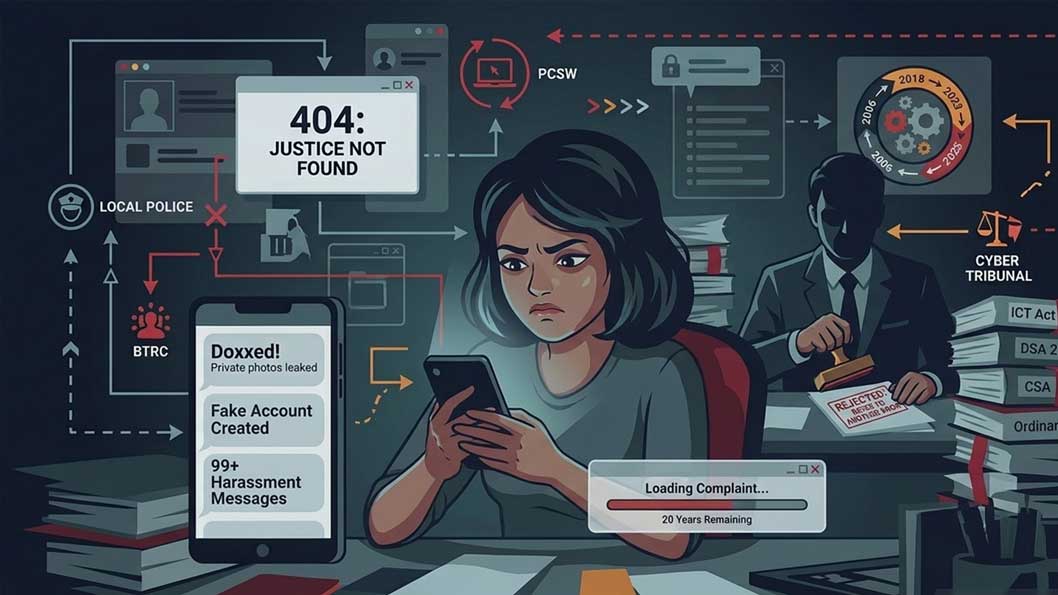
Ask a young woman in Dhaka who has just been harassed online where she is supposed to go, and you will discover something that no statute admits to the state has never actually told her. Bangladesh has passed three major cyber laws since 2006. Each law has been announced as the correction of the last. Each came with a newly named agency, and each was celebrated. However, after two decades of legislative effort, the overwhelming victims of online harassment never go for a complaint. This is not the background of the digital rights in Bangladesh. It is the main plot of digital rights in the country.
It is easier to put this into the familiar tale of weak enforcement; the story of good laws not being executed by an indifferent or corrupt implementation apparatus. But that reading misses a very significant truth. In Bangladesh, or in region like South Asia, the problem stems before the enforcement altogether. Before a law is enforced, overlooked, or not used, the law needs to be readable and found. It requires legibility, readability, to the beneficiaries. At this level of findability, a great deal of state’s promise to protect its citizens quietly disappears.
This is worth dwelling on because it inverts an assumption common in writing on rights in the Global South: that the gap between law and life is mainly one of political will, resources, or corruption. Sometimes it is. But sometimes the gap is structural in a more mundane sense — a gap of architecture. A citizen harmed online in Bangladesh faces not one clear channel to justice but at least six competing ones, each opened by a different piece of legislation: a General Diary (GD) or First Information Report (FIR) at a local police station, escalation to the Cyber Crime Investigation Division or the Counter Terrorism and Transnational Crime Unit, a dedicated women’s cyber-support desk (PCSW), the national 999 emergency line, or a direct complaint to one of eight regional Cyber Tribunals. Each one is equipped with its own standing rules. The police complaints require only the victims to walk in; the Tribunal complaints can only be lodged by the aggrieved person or her written nominee and dismissed outright at first hearing. These distinct features are all recoverable from statute. However, none of it can be traced from a single public document if a first-time complainant attempts to. If a victim knocks on the wrong door, in most cases, she is not redirected but turned away. This feature becomes more significant, as the victims of online harm are not prone to redressing the issue.
This scenario is exacerbated by the fact that the underlying law has been rewritten three times in the last twenty years, the Information and Communication Technology Act of 2018, the Digital Security Act of 2018, and the Cyber Security Act of 2023, and after the political shift in 2024, the Cyber Security Ordinance of 2025. Even the citation has not stayed the same. The harassment-related provision has been sectioned under “Section 25” across three consecutive regimes. But each has criminalized a different offence, carried a different penalty, and fell under a different agency each time. If a citizen remembers “Section 25”, he would be both right and wrong, under the next law. This is not about the enforcement failure but has made legibility an issue of its own reform. Each reform requires the public to unlearn and relearn. The pattern is evident from the record also. A survey by ActionAid survey in 2022 reported that 63.51% of women respondents experienced from online harassment. Another independent survey by the police documented not knowing how to report as one of three recurring reasons for not reporting, along with doubts about outcomes and fear of secondary victimization.
The Sociology of law can provide useful concepts for this. James Scott has formulated the idea of state’s “legibility”. It refers to how administrations render complex social reality into standardized categories. This helps officials, and reciprocally citizens, to read and act on. If this simplification is unstable, there are issues of navigation on both sides. Along with this, the work of Lipsky can be meaningful. His idea of “street-level bureaucracy” contextualizes the gap between policy and practice not in the statute book but at the front counter. Reading these together gives a precise understanding of something which is usually described only as “red tape”. A complaint architecture can be entirely lawful, equipped with proper officials, and still functionally unreachable, because of the space between the institutions.
This can be extended well beyond Bangladesh and understood better with a comparison of the neighboring country. India’s National Cyber Crime Reporting Portal integrates the complaints into one single entry point with its own helpline and dedicated channel. The complaint is trackable through a reference number. The case is not argued as a clean success story. Critics have argued that its due-process safeguards are repeatedly subordinated to its crime-control priorities. However, the comparison helps to argue why a durable point of entry can be a design choice. Bangladesh’s institutional architecture of six doors is a path-dependent outcome of its own legislative history, not an inevitable feature of digital governance.
This doesn’t argue against legal reform or work to make the enforcement quality better. Both matters. It draws attention to the aspect of access to justice that is less talked over than drafting or implementation. A system’s architecture requires to be stable and explained long enough in simple terms for its citizens to benefit from it. A referral map telling a complainant which door to use, and what happens if she gets it wrong, costs almost nothing next to the legislative apparatus that produced the doors. Even Bangladesh’s PCSW women’s desk, whose remit is clearly stated and reportedly approached some sixty thousand times by late 2024, does not explain how a complaint there relates to a parallel police report or a Tribunal escalation.
There is also a harder point here, one that should trouble anyone inclined to treat digital rights primarily as a drafting problem. If a redress system is illegible by design or neglect, harassment aimed at silencing women’s public voices does not just go unpunished. It also becomes cheaper to inflict, because the cost of seeking recourse is quietly shifted onto the victim as institutional maze-running. Illegibility is not a neutral gap; it has a distributive politics of its own.
The argument, here, is not that Bangladesh needs another cyber law. It has had three in under two decades, and a fourth would very likely reproduce the same problem in a new name. It is that somewhere between the statute and the street, a state has to decide whether it wants to be found.
Ishtiaq Mohammod Fakhruddin is a Senior Lecturer in the Department of Sociology at East West University, Dhaka. He can be reached at ishtiaqjamikds@gmail.com.