
“The revolution lags behind itself.”
—Henri Lefebvre, The Explosion: Marxism and the French Upheaval
“I hope to find
“What is denied to me.”
–Paul Eluard, ‘The Corner’ (1937)
Theory on the Run: What and Why?
It is perhaps in the fitness of things that one begins with a confession. What follows here, by way of putting together some thoughts on the riotous students-youth+ eruptions that have recently shaken up different cities and towns of India, their epicentre being the Parliament march on July 20, is not at all an instance of the philosophically wise Owl of Minerva taking wing at dusk. Rather, it is rough-and-ready theory on the run. But what is the point of trying to do something this provisional in theory?
Rosa Luxemburg, in a January 1919 article entitled ‘Order Prevails in Berlin’, written soon after the defeat of the Spartacist uprising of the German proletariat, and hours before her capture and assassination by the Freikorps, a counter-revolutionary militia, contends: “Because of the contradiction in the early stages of the revolutionary process between the task being sharply posed and the absence of any preconditions to resolve it, individual battles of the revolution end in formal defeat. But revolution is the only form of ‘war’ – and this is another peculiar law of history – in which the ultimate victory can be prepared only by a series of ‘defeats.’” [Emphases added.] This means that every moment in a “revolutionary process” must prepare to fail and, at once, grasp such failure precisely, in order, to find “ultimate victory”.
In other words, every evental moment that in the transience of its now-time posits a radically transformative process must strive, following Samuel Beckett’s Worstward Ho, to “fail better” when it “fail(s) again”. This means that every moment in such a “series of ‘defeats’” must always necessarily be at a higher level of defeat than all its prior moments.
It is at this point that theory on the run becomes imperative. A theoretical endeavour must necessarily run after the radical or the evental moment of rupture precisely after its interruption and hypostasis, and its constitutive incorporation into a new, more dispersed composition of capitalist social power; such a composition, as we will see later, is necessarily a more intensified and concentrated regime of accumulation. Only in this process of running after the radical moment, which has disappeared into the recomposed structure of capitalist social power, can such an endeavour prepare the ground for the evental moment-to-come to be defeated at a higher level.
But how are we to understand eventality? The event, following Alain Badiou, must be grasped as a moment of taking place in its evanescence or transient nowness. The event, therefore, is that which is not placed because it is the taking place. This, therefore, means that it is a break with the historically given composition of the law of the place or the structure constitutive of places. Such places necessarily exist in a qualitatively commensurable and thus differentially included relationality with one another. The event is therefore also tantamount to the suspension of the law of the place or structure as manifested in its historically given composition or regime. The evental is, therefore, the tendency and force of determinate negation of the law of the place and the abstraction of mutual commensurability that underpins such a regime. In this sense, it is irreducible and thus singular concrete materiality, which also posits this universalisable truth about itself. This, admittedly, is an attempt to read Badiou’s conceptions of the event and the evental through the prism of Marxian critique of political economy.
In such circumstances, the aforementioned theoretical endeavour must seek to clarify the historical conditions that necessitated the lapse of a moment of radical eruption or eventality, which in its lapse loses its evental force and thus the real possibility of its universalisability. Consequently, such a theoretical endeavour becomes the determinate articulation of the truth of that evental force – or, of universal-singularity, as it were.
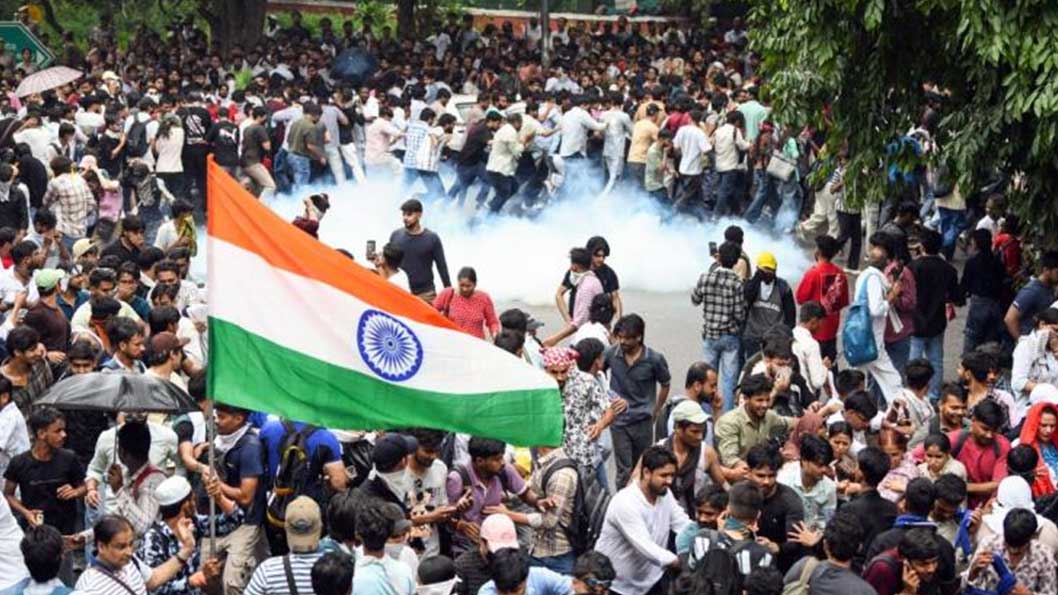
One can embark on such an endeavour only by first and foremost identifying the actuality of the evental (and thus radical) dimension of an upsurge that usually stems from protest movements launched by or in the name of an amorphous people. The fugitive notes here, occasioned by the July 20 upheaval in and around Lutyens’ Delhi, and its viral propagation to other cities and towns of India, begin by attempting to do precisely that.
The Radical Moment in Lutyens’ Delhi and Why it Disappeared
The massive students-youth+ upsurge at Jantar Mantar, and in and around Lutyens’ Delhi was highly variegated not only in terms of the class-segmental locations of its various actors, but also vis-à-vis the heterogeneity of ideological self-representations of different and mutually contradictory (and even antagonistic) class positions. This is a no-brainer.
The radicalism of that upsurge did not lie in the reformist demands it formally raised while marching to Parliament – demands that had been decreed by the likes of the Cockroach Janata Party (CJP), Sonam Wangchuk, and their various leftist allies. Neither did it, as a result, stem from what the upsurge subsequently came to say about itself in its socially averaged consensus or unanimity. Its radicalism lay instead in what the mass upsurge amounted to in its performativity: a dynamic collective subject, or a pulsating, delocalising “social humanity” or “social individual” (Karl Marx). Such performativity exceeded the politico-ideological bounds of liberal constitutionalism and republican populism, of which those demands were (constative) statements.
This (performative) radicalism lay in the evacuation of capitalist class (and state) power; something the upsurge effectuated by breaking down, if we were to look at it in purely objective terms, the organisation of some of the segmented, hierarchically partitioned or differentially inclusive sociality of space-times constitutive of the so-called Delhi National Capital Region (NCR).
Lutyens’ Delhi demonstrates, in relation to the rest of Delhi NCR, the hierarchising articulation of state power of globalised capitalism in its Indian specificity, especially the power of its Indian political executive. The massive movement of masses in and through that space, during and in the wake of the July 20 Parliament march, articulated the ‘form’ of general assembly as a direct democracy. Such an assembly implies the abolition of the legislative-executive hierarchy. In other words, it quite evidently tends to suspend social segmentation of the intellectual qua thought (legislation) and the manual or sensuous-material of doing (execution) by rendering that hierarchy dynamic through the functional rotation of the activity of legislation (thought) and execution (doing). It is, therefore, the annihilation of rationalisation or social mediation that distributes legislation (the intellectual) and execution (the manual) into a mutually segmented hierarchy.
In this precise sense, the objective situation of general assembly in and around Jantar Mantar on July 20, the day of the Parliament march, and for the next couple of days implied the evacuation of the hierarchising articulation of capitalist state and social power in that area. As a consequence, that moment of mass articulation, which also registered itself as a transgressive festival of jouissance, posited in an embryonic mode the destruction of the capitalist politico-economic geography of Delhi-NCR. It also, at once, posited, admittedly in its incipience, an affirmative communising process in its (ontological) subtraction vis- à-vis such a geography – one that is structurally undergirded by the law of the place. The various riotous protests, which rapidly spread across India —particularly to Calcutta and some cities and towns of Bihar — kept (re)commencing the subversion of the segmented space-times constitutive of those places over the next couple of days.
This militant dimension of those upsurges needed to be relayed back almost immediately to the collectivity of their actors through clarification and investigative propaganda. Such a manoeuvre, in the case of mass upsurges like those being discussed here, is indispensable if the various anti-capitalist and, dare one say, proletarian position(s) within amorphously populist protest movements underlying such upheavals are to be concentrated.
Only through such concentration of radical working-class tendencies — that is, the tendencies of “negativity in relation to itself” (Marx), or “nonidentity of nonidentity” (Theodor Adorno) — can the contradictions internal to such upsurges turn sharper. That is essential if such mass upheavals are not to rapidly dissipate by running into the limits imposed on them by the default politico-ideological forms of liberal constitutionalism and populism.
The lack of such inquiry-driven, theoretically articulated clarification of the July 20 mass upsurge in Lutyens’ Delhi, and the resulting absence of a generalising radical-tactical orientation for what would follow movementally from that upsurge, ensured that the evental dimension it instantiated was captured by the populist and constitutionalist politico-ideological forms. Forms in which the month-long protest movement that preceded the July 20 eruption had been encaged, not ineffectively, by the CJP leadership, the likes of Wangchuk, sundry Gandhian ‘socialists’, the bureaucrats of so-called communist organisations, a handful of ‘decolonial’ academics, and a bunch of ideologues of Ambedkarist persuasion.
[It ought to be stated here as an aside that the CJP’s allies, most of them student fronts of various left organisations and so-called communist parties, which are now no more than electorally-driven social corporations and/or visibility-chasing populist communities, have been propelled largely by the impulse to reap the numerical yield of the crop the CJP had sown in calling for Dharmendra Pradhan’s resignation as the Union education minister.]
The enmeshing of the evental dimension of the July 20 upsurge with the status quoist, at best, militantly reformist, politico-ideological forms purveyed by the CJP and its left-populist allies and backers was all but unavoidable. In such circumstances, it becomes particularly crucial that we demonstrate how the two could and should have been analytically separated from one another, the grain from the chaff as it were. Such a demonstration, one reckons, will constitute an interventionist attempt towards enabling the process of their separation, both in analysis and in practice, when a similar mass upheaval with a pronounced evental dimension occurs next.
The Precariat and the ‘Cockroach’ Phenomenon
For that purpose, the CJP experience needs to be opened up a little. What underlies the ‘cockroach’ phenomenon is, without doubt, a conjuncturally objective radical possibility that is embedded in the steady and marked reduction in social wages (and subjective wages, too) of a new composition and generation of utterly precarious mass workers or cognitarians, who also happen to be ‘entrepreneurs’ of selfhood, or, to be accurate, proletarians of the consciousness industry. This industry is underpinned by financialisation-fuelled big-data capitalism of social media, large language models and AI, and it consists of unwaged or fitfully waged affective labourers engaged in bio-capitalist “immaterial production” (Toni Negri) in the social factory called life. The ‘cockroach’ phenomenon stems from an objectively given radical possibility that resides in the drastic cuts in social and subjective wages of mass workers, who are now not only sellers of the vendible commodity of labour-power but are also ‘entrepreneurs’ of their selfhood and social life and thus “social workers” (Negri); they are members of a steadily and irreversibly burgeoning “relative surplus population” (Marx) — the population of the unemployed and/or the flexibly or precariously employed. But, most importantly, the phenomenon in question is characterised by such objectively given radical possibility realising itself politically through its mystified, and thus status quoist and, in the final analysis, reactionary subjective form of the individuated or private ‘GEN-Z’ citizen-consumer.
Anti-corruption movements and/or protest movements against poor governance, etc., especially in this conjuncture, frame the real question of cuts in what we contend are social and subjective wages in mystified terms of the citizen-consumer’s struggle against an executive of inefficient service providers. Such movements not only reinforce the status quo but run the grave risk of ultimately turning reactionary. They further intensify the generalisation of the anti-worker, anti-working-class orientation of the neoliberal consumer-subject. This tends to multiply, deepen and reinforce all kinds of economic and social-identitarian segmentation of precarity within social labour, which, on the whole, is now extremely precarious.
Arguably, the ‘cockroach’ phenomenon, which also includes all the left-populist allies of the CJP, is, mutatis mutandis, India Against Corruption (IAC) redux; albeit raised to at least the power of two. Hence, in the final analysis, it is likely to heavily contribute to the generation of a more intensified form of mystified inversion of an objectively even sharper radical possibility into an even more starkly barbarised and reactionary actuality. However, the heightened instability of such a hyper-mystified form is also why the probability of its objectively radical content overflowing its formal mystification is that much higher. This is precisely why the upsurge of July 20, which erupted from within the CJP-mediated protest movement, had an unmistakable evental dimension while nothing remotely akin to that was witnessed during the 2011-12 IAC agitation of Anna Hazare-Arvind Kejriwal fame.
Yet, all said and done, the ‘cockroach’ protest movement, in its operation—up until the July 20 eruption and now more than a month after it—has been an everyday spectacle in the Situationist sense of social life consuming itself in its (now digitally) generalised hyper-commoditisation. The theoretical and investigative-propagandist interventions outlined, had they been attempted, would have aided, in some measure, the separation of the objective radical possibility and its own incipiently radical subjective articulation from their mystified subjective realisation and/or hypostatised capture.
To insist on such interventions is therefore indispensable if a July 20-type of upsurge in the near future is to effectively resist its mystified inversion – such inversion would, for one, amount to its culmination in the triumph of a CJP-like civic-populist project. Such a mystified denouement could even include a spectacular change of executive guard, electorally effected or otherwise, in the Indian state formation. Given this structurally crisis-ridden and thus utterly precarious (global) conjuncture of later-than-late capitalism or neoliberalism, that would be no more (or less) than the system’s objective way of providing the flagging majoritarian counter-revolution with the much-needed respite to recharge its politico-ideological batteries and a renewed opportunity to return in triumph with never-before-seen vengeance.
We can now perhaps see more clearly that neither the CJP nor its left-populist allies is the primary problem. The real problem, as far as we are concerned, lies in the liberal-constitutionalist and populist politico-ideological forms that almost inevitably capture the evental dimension and radicalism of mass upsurges, which tend to erupt from within protest movements launched by or in terms of an amorphous people. [The CJP, its allies and its backers have merely been historical embodiments of those forms.] Such forms are not imposed on such radical moments. Rather, they inhere in those very upsurges, to say nothing of the protest movements from within which they erupt, on account of both their epochal (capitalist) determinateness and their conjunctural (neoliberal) specificity.
Let us try to illustrate this by marking the impersonal, almost automatic, operation of the asymmetrical dialectic between the evental dimension of a mass upsurge and its conversion into a spectacle through the interruption and hypostasis of that dimension.
General Intellect vs. Collective Intelligence: In and Against the Social Mediatic Spectacle
The phenomenon of the widespread use of smartphone cameras to shoot videos and click pictures, and upload them on social media in the midst of the July 20 upsurge and the massive police repression unleashed on it at the barricades was arguably a case of re-appropriation of the “general intellect” (Marx). [The general intellect (or the socio-technical machine) being, in this instance, the social media and its barbarised public sphere – basically, the social factory and the domain of consciousness industry.] This had meant the conversion of that general intellect and its abstract impersonal power back into the collective intelligence of the socially cooperative activity of communicative-relationality – the general intellect in question having been an automation and abstraction through expropriation of such social (or cooperative) doing in the first place. This transformation of the general intellect back into collective intelligence, or the social individual, was discernible in the way the social operation of technology tended to force the truth of the evental dimension of the upsurge in propagating it. It becomes evident if we pay attention to how those videos and photographs on social media surpassed and broke all algorithms and functioned as a material force that induced more such riotous instants, which briefly dismantled the segmented sociality of space-times in other towns and cities of India.
In this instance, the images on social media were bearers of the viral material force that produced and constellated the different moments of the radical sequence — unleashed by the July 20 mass upsurge in Lutyens’ Delhi across various parts of the country — into a nascent process of collective subjectivisation.
The videos and pictures generated and uploaded on social media during the July 20 eruption and the brutal crackdown that followed were, at the time, not consumed as affective digital commodities by passive, contemplative subjects. Instead, they induced the eruption of multiple singular instants by enabling those instants to partake in one another’s singularity, precisely in and through their generic condition of mutual irreducibility. This rendered them moments in a process of collective subjectivisation. Those singular instants, in being the suspension of the subject-object dialectic in its duality, are moments of “subjective materiality” (Badiou). Smartphones with cameras became extensions of bodies partaking of each other as singular instants of that collective subjectivity.
It was as if the subjectivity of a political unconscious had taken control of the smartphone cameras and social media, and was in complete command. This continued for another couple of days in both Lutyens’ Delhi and other similarly insurgent space-times elsewhere in the country. But attempts at theoretical clarification and attendant propaganda, which should have rapidly emerged from this experience, remained, for all effective purposes, missing. As a result, the impersonal social-mediatic logic of consciousness industry and bio-capitalist production of spectacle began to steadily seep back into the milieux of the agitators in Lutyens’ Delhi and, with some lag, elsewhere, too.
As our comrades Deepanshu Mahajan, Pratyush Nirjher and Parul Singh observed with acuity at Jantar Mantar on the evening of July 24, the phone cameras had regressed to once again become the machinic components of the social-mediatic public/general intellect that mediates among affective workers, who are the dispersed cogs of a heavily concentrated social-mediatised consciousness industry. The protestors in and around Jantar Mantar were, on that day, seen interacting with one another and with themselves as individuals mostly to shoot videos and make reels of those interactions and of themselves in ‘action’. Those videos, reels and pictures were nothing but images of forms of being that the July 20 mass upsurge had produced and which had settled down post hoc. Not surprisingly, those images have since been disseminated through the newly reconstituted social media algorithms for passive consumption and emotionally charged ‘enjoyment’ by all and sundry – including the milieux of the protestors who produced them. As a consequence, what we have had since is congelation of determinate indices of the evental dimension of the July 20 mass upsurge into revisionist ideological forms of populist-communitarian socialisation and juridical politics, even as their images have necessarily become constituents of a society of neoliberal spectacle.
The acute observations of our comrades and the descriptive detailing they have sparked have cleared the ground for an exercise in theoretical explication. It will not do justice to those observations if we shy away from treading that cleared ground and think that our work is done in merely recording those observations with a bit of description added.
The ‘Radical’ Subversion of Subversive Profanities
Description masquerading as theory is, unfortunately, what has been on offer — if and when theory has been offered at all — vis-à-vis the Jantar Mantar protest movement. This has been most in evidence in the articulations of some academic purveyors of chichi ‘radical theory’ on the rather important question of the use of profanities and obscenities as doggerels, slogans, placards and social-media memes by the ‘Gen-Z’ protestors. In what they likely believe to be their grungily subtle theoretical affirmation of such deployment of swear-words and obscenities by the protesting masses, all that those ‘radical’ academics have come up with are truisms: the ‘Gen-Z’ protestors have, through the use of profanities and obscene humour, mocked the autocratic power of the current dispensation and refused all engagement with it, etc. The failure of such ‘theorisation’ to go beyond the obvious will now only serve to freeze, if it hasn’t already, the phenomenal appearances of profanity- and expletive-riddled slogans, placards and memes into units of a fetishised and settled grammar of ‘radical’ politics; a grammar that will render such ‘radical’ politics a bio-capitalist phenomenon of production of a permanently unfolding scandal and its cathartic consumption.
There has been one notable exception, though. Marxist intellectual and Ambedkar scholar Anand Teltumbde has, in a profound theoretical article for TheWire.in, transformed such truisms into a sagacious elaboration on how profanities and expletives, through their deployment by the protesting masses against the apparent sacredness of power, posited a radically new plane of counter-power.
Yet, something rather critical is missing even in Teltumbde’s otherwise insightful articulation. The piece hardly tries to theorise the epochal (capitalist) and conjunctural (neoliberal) specificities of the strategic core of such anti-authoritarian deployment of bawdiness and ribaldry. Only by attempting to unveil the radical strategic truth at the heart of those bawdy and ribald slogans and memes can one take another crucial step towards bringing into being the kind of counter-power he likely has in mind.
Profanities and obscenities directed at an authoritarian dispensation of reactionary thugs, windbags and buffoons, such as the one helmed by Narendra Modi, constitute an incipient articulation of radically egalitarian counter-power because it amounts to, first and foremost, a break with the imperative temper that sits within each one of us, and interpellates us into individuated/private or sovereign subjects. This imperative temper, if we were to follow one of the key arguments of Civilization and its Discontents, among other similar texts by Sigmund Freud, is “the law of the father” (in Lacanian conceptual vocabulary). It is precisely for this reason that the anti-government ribaldry in its unforeseen eruption at Jantar Mantar was, in being anti-authoritarian, also, at once, directed against patriarchy – patriarchy that is arguably constitutive of and indispensable for capitalism at a fundamental structural level.
The law of the father interpellates individuated, private or sovereign subjects into being by regulating and regimenting the affective (read negative-productive) forces of desire. And such subjects are the basic units of exchange (or juridical) relations, which, following Marx in Capital, Volume I, are the reflex of capitalist social relations of production. This kind of break, on a mass scale, with the law of the father qua the imperative temper is, therefore, a refusal to be interpellated by it as individuated subjects, thereby evacuating each of those subjects of themselves and thus of capitalist class power. That, in turn, can be nothing save an incipient articulation of collective subjectivisation – or, the “real movement” or process of communisation.
Such collective subjectivisation is (ontological) subtraction from the impersonal power of abstract domination, and is thus, at once, its suspension, too. Such subtractively ontological collective subjectivisation is a process of singular subjective instants partaking of one another precisely through their generic condition of mutual irreducibility. This was registered, for instance, in a surge of mass intimacy, sharing and care during certain key moments of the Jantar Mantar movement – particularly during and immediately after the July 20 upheaval. In this precise context, they were affective articulations constitutive of the general assembly-like situation, and the direct democracy it necessarily engendered. They were, therefore, embryonic articulations of councillist-type collective organising of the entirety of life (both in its productive and reproductive aspects) in perpetually dynamic openness.
Many of our patronising ‘radical’ theorists and avuncular (and materteral) left-populist backers of the movement have probably still not tired of waxing eloquent about that ‘affective’ explosion even as they have continued to blithely miss the wood of general assembly and collective subjectivisation, admittedly in their incipience, for the trees of mass intimacy, care and celebratory enjoyment. The latter were merely the appearances and registers of the former. And unless we grasp the latter in their instantiations as, at once, the instantiations of the former, we cannot theorise and concretely envisage the generalisation of that embryonic mode of collective subjectivisation.
Our ‘radical’ aunts and uncles – not without a little help from their clientele of nieces and nephews among the ‘Gen-Z’ protestors in Lutyens’ Delhi – have squarely failed on that count, thanks to their patronisingly affirmative ‘theoretical’ engagement with the protests. This is yet another instance of how such purportedly solidaristic interventions have sought to cleanse the movement of all its elemental radicality: its capacity for law-unravelling violence. This time it has been accomplished by turning the movement into an easily digestible affective commodity of warm-and-fuzzy populist communitarianism.
The Law of the Father in the Neoliberal Conjuncture
But let us leave such codswallop at that, and focus on a more politically productive question: why has such concerted refusal of the law of the father occurred on such a massive scale only now? Of course, such a novelty cannot be anything other than an aleatory occurrence. Yet, every such aleatory occurrence is the actuality of a determinate and thus real, as opposed to abstract, possibility. What should, therefore, be recognised is its conjuncturally specific condition of possibility.
The eruption of anti-authoritarian, anti-patriarchal irreverence during the recent mass upheavals in and around Delhi’s Jantar Mantar, and in other parts of the country arguably emerges from a moment in our history when the paternalistic (and thus patriarchal) power of authority or the (phallocentric) law of the father reveals its crisis by failing to guarantee, in any meaningful and effective sense, the fixity and thus certainty of one’s economic and socio-political place in the world as an individuated or sovereign subject.
Authority exists both in the form of visible institutional figures exercising their power of regulation and regimentation within their juridical and thus individuated institutional spheres of operation, and as the invisible imperative temper that sits within each individuated self by way of interpellating it. In this precise sense, authority is necessarily phallocentric and thus patriarchal. In exercising itself, authority fixes individuated subjects to their respective places by way of interpellating them as those subjects. And by the reckoning of Freudian psychoanalysis, is this not what the phallus, too, seeks to do vis-à-vis its object, which exists as a subject only as a measure given to it by the phallus?
The current regime of capital accumulation and the technical composition of social labour concomitant with it, which are constitutive of our later-than-late capitalist conjuncture, are, as in a cybernetic, and thus progressively heightening, feedback loop, both the cause and consequence of the aforementioned crisis of the intrinsically phallic (or patriarchal) authority. That is so, first and foremost, because unforeseen levels of all-round footlooseness characterise this conjuncture, and the regime of accumulation and the technical composition of labour constitutive of it.
The same type of conjunctural condition had also made possible the riotous workers’ revolts in IMT Manesar and Noida earlier in April. The completely footloose character of the thoroughly de-skilled and utterly precarious mass worker orientates and informs her or his increasing propensity to destroy and/or burn down factories or her or his places of work, and the surrounding infrastructure. That also explains why such mass workers are no longer particularly interested in occupying factories, engaging in sit-ins outside them and so on. There is clearly a similitude here between such workers’ revolts and the deployment of ribaldry against Modi and his government of goons. This tendency of the latter is, in its subjective orientation, no less riotously destructive than what the former so unambiguously expressed in April. But such riotous destructiveness can generalise the counter-power of collective subjectivisation it incipiently posits, only when it grasps and affirms itself thus in its elemental radicality.
All attempts by the populist formations in play – the CJP, sundry ‘left-liberal’ individuals and their informal groups, and students’ and youth fronts of fusty Leninist organisations — to incorporate the footloose actors of such a riotously ribald agitation into their patronage networks or within the fold of their respective organisations, all in the name of organising the (constituent) power of those subjects for some larger anti-systemic politics, are bound to come to a naught. Such attempts will, of course, enable the expansion of those networks and political groups. But they will equally inevitably mystify this radically riotous mass by effecting, inadvertently or otherwise, a re-segmentation of the footlooseness of their constituent subjects. This would trigger the transformation of that mass back into a counter-revolutionary terrain of a more barbarised fratricidal conflict between the tendencies of progressivist status quoists and system-reconstituting reactionaries – basically, an uber-intensified Hobbesian war of all against all, which will further reinforce the exceptional Hobbesian nature of the state.
Unfortunately, this process of re-segmentation of the protesting masses kicked in in tandem with the waning of the evental truth of the July 20 upsurge; a truth that vanished not too slowly at all. On July 24, for instance, our comrades saw that a barrier had come up between some of the area immediately around the stage set up for the CJP leaders and their left-populist allies, and the rest of the space occupied by the protesting masses at large. This was a case of re-segmentation of the general assembly-like situation that the July 20 upsurge had articulated and tended to institute — a situation that had lingered for the next couple of days. Such a barrier served to separate the mass of protestors as such and their insurgent space from the masses-elect of the CJP and its left-populist allies, and their organisationally controlled spatial sphere.
At this point, a close investigation into the conjunctural specificity of this condition of unprecedented footlooseness and the radical subjectivities it tends to generate becomes vital. A theoretical attempt here and a conceptual effort there have been made in that direction putatively from the vantage point of committed class politics. But such attempts have inevitably been caught in the web of various sociologically seductive indices and registers of footlooseness and its corresponding radical subjective tendencies. That has meant, once again, missing the wood for the trees, and, as a result, the sociologised fetishisation of the subjectivity of radical class politics. Sometimes the best of ‘Marxist’ intentions, it seems, are not good enough!
To fixate on the sociological indices of certain sections of the protestors, who displayed a devil-may-care attitude on the barricades vis-à-vis coercive manoeuvres by the police, paramilitary forces, and militias of the Sangh parivar, and the radical subjective orientation that such an attitude instantiated at the moment, was a temptation hard to resist for those aching to be identified as theoreticians of radical working-class politics. The result: the sociological index in question was transformed (read reified), directly and in its empirical immediacy, into a subjective figure of radical class politics. What was, as a result, glaringly absent in such impressionistic ‘theorisation’ of radical class politics is the explication of this devil-may-care attitude on the barricades, and the radical subjective orientation that such an attitude doubtless instantiated, in terms of its conjunctural condition of possibility.
Instead of conflating such an attitude with the sociology that manifested it, efforts should have been made to access, precisely through the sociology in question, its determinate or historically specific production. Only then would the attitude in question have disclosed itself as the outcome of unprecedented levels of abstraction and massification of labour in its social-industrial entirety; something produced by hitherto unmatched levels of all-round de-skilling (same-skilling), thanks to across-the-board functional simplification of the labour process through its increasing cognitivisation (and thus increasing de-manualisation) due to an exponential system-wide rise in the organic composition of capital.
The organic composition of capital is the ratio of constant capital (capital invested as means of production and raw materials) and variable capital (the share of invested capital paid as wages or the price of labour-power as an expression of its variable value). Its significant increase across the entire capitalist world-system has, not surprisingly, implied a concomitant qualitative leap in the overall socio-technical modality of automation or the general intellect. This leap is evident in the predominance of microelectronics, information technology, social media, large language models and AI in the social-industrial process of production and reproduction. Such a paradigm shift is discernible in two phenomena. One is, of course, a never-before-seen growth in relative surplus population, thanks to large-scale expulsion of living labour from the production process (or the sphere of its productive employment). The second is an unmatched degree of precarisation of socio-economic segmentation of social labour as a whole, and, as a result, the same heightened pitch of destabilisation of its socio-political segmentation, too. The latter stands registered in the progressively deepening footloosness and barbarisation of both the private and public spheres of so-called civil society – the zone of social (re)production of the vendible commodity of labour-power and its circulation. Concomitant with this is the intensifying instability of political society and of arbitrariness and authoritarianism of the state. This is the relentlessly deepening barbarisation that is now our quotidian experience.
In such circumstances, to have engaged in a concrete analysis of the empirically concrete situation of nonchalance on the barricades would have meant making sense of this combatively militant attitude as an expression of a tendency that stemmed from our conjunctural condition of unprecedented precarity and thus all-round footlooseness. That, in turn, would have shown how and why the subject, which emanates from such an empirically concrete and thus sociologically indexed location, is, in its operation, necessarily riven into two mutually antagonistic (subjective) tendencies. Of these two tendencies, one is, of course, that of the ontologically subtractive collective subjectivisation – one that had unquestionably been posited in its incipience by the devil-may-care attitude of a section of protestors on the barricades in the aftermath of the July 20 incident. But there is then, equally, the second tendency, which is antagonistic to the first. This is the mystified form of expression of the reactionary sovereign subject of the spectacle-seeking counter-revolutionary mob.
To rigorously affirm and generalise the first, one must also, at once, prefiguratively discern in the empiric (or the sociological index) of its operation the articulation of the second, which is the default tendency that interrupts and tends to negate the first (subjective) tendency of subtraction and negation. Not unlike in Kafka, hope must be on the same plane as despair, and should, therefore, operate in an ironic vein.
The sociology of a section of the Jantar Mantar protestors that, post July 20, was riotously combative on the barricades in the face of police repression was, as a manifestation of such combativeness, the monadic index of (an anti-Hegelian) aufheben (or preservation) of (Benjaminian) blasting out, or of determinate negation itself; something that in its generalised actuality would have amounted to persistent and hence prefigurative negation. It was, therefore, at once, the index of determinate instantiation and thus a monad of the affirmationist organising of communisation. But had it been more closely probed, this sociology of riotous destructiveness was bound to be found internally and tendentially divided, to be, at the same time, the form of a ‘nihilistic’ sovereign subject, which expressed the same riotous destructiveness to demolish precisely the radically emancipatory (self-)organisation of communisation itself. Such a subject, needless to say, would be reactionary. After all, so many of the combatively militant Jantar Mantar protestors had, by their own admission, been voters of the BJP, ardent supporters of Modi’s brand of Hindu majoritarianism, and, in some cases, members of the RSS. This bears out our contention that, thanks to unprecedented precarity and unparalleled footlooseness — key specificities of our neoliberal conjuncture — reaction and radicalism tend now to morph so rapidly into each other as to be quite indistinguishable. So, if reaction, as the above example shows, has turned militantly radical, this process can as easily be reversed swiftly.
Clearly, any one-sided fetishisation of sociological indices of such instances of riotous combativeness – observed not only in the wake of the July 20 incident in Delhi and elsewhere in India, but also during other recent mass upsurges in Sri Lanka, Bangladesh, Indonesia and Nepal — as categories of the radical working-class subject would do no more than precisely undermine the project of radical working-class politics. In fact, such one-sided and thus sociologically fetishised categories of supposedly radical class subjects would turn out to be no less than yet another unit of the categorial lexicon of left-populist republicanism, whose logic of social averaging is constitutive of its categories such as the people, the public, the common man, the citizen and so on. Such categories are arguably programmed to take a reactionary turn in the barbarously benighted neoliberal conjuncture that we inhabit.
Ambivalent Politics, Hyper-Precarity and the Crisis of Overaccumulation
Considering that unprecedented precarity and all-pervasive footlooseness constitute the source of this peculiarly ambivalent situation vis-à-vis politics, we would do well to delve a little more into the nature of this neoliberal conjuncture. Such an inquiry shall enable us to zero in on how and why its characteristic features of unprecedented precarity and footlooseness yield, insofar as the interplay of mutually antagonistic tendencies is concerned, such a peculiarly equivocal operation of politics.
Let us rehearse a previous argument. The exponential, system-wide increase in the organic composition of capital (C/V) effectuates such precarity and thus footlooseness because of near-complete abstraction of social labour; that, in turn, is a function of a hitherto unparalleled scale of all-pervasive de-skilling (same-skilling) through heightened cognitivisation and functional simplification of the labour process. Such an increase in the organic composition of capital, in following through the logic of Marx’s explication of that concept in Capital, Volumes I and III, has obviously meant an equally significant system-wide rise in the technical composition of capital (TCC). [The TCC is the ratio of the physical mass of the means of production (machinery and raw materials) used in the production process to the mass of labour-power (labourers) therein employed.] Such a marked increase in the TCC has led to a system-wide deepening of the problem of extraction of relative surplus-value (surplus labour time) – in other words, an intensification of an overall crisis in exploitation (the ratio of surplus labour time to necessary labour time). An increase in the TCC necessarily implies a significant reduction in socially necessary labour-time, which, in turn, indicates a tendency for a marked diminution in necessary labour-time (the variable value of labour-power expressed in its wage) across the board.
This has, of course, led to the large-scale expulsion of labouring bodies as repositories of the abstract capacity for living labour (labour-power) from the production process into the ranks of the highly de-skilled and now uncontrollably growing relative surplus population. It has therefore also resulted in significant diminution in the magnitude of surplus labour-time (surplus-value) released to be realised as profit for further capital accumulation. So much so that a further enhancement in the overall productive power by way of stepping up even more the system-wide organic composition of capital and thus the TCC, too – through more investment (accumulation) of capital to automate even more the globally integrated production and labour processes – would cause the capitalist world-system to undercut itself and collapse. The capitalist world-system now stands on the brink of collapse. Its crisis of overaccumulation is no longer cyclical. It is structural, and thus permanent and terminal.
This structural crisis of overaccumulation – which, more often than not, is accompanied by its twin, the crisis of overproduction – indicates that the process of real subsumption of labour (living concrete labour) by capital (dead human labour in the abstract) is well-nigh complete. This, as Negri tells us in ‘First Displacement: The Time of Subsumed Being’, in his seminal Time for Revolution, amounts to the “tautologisation” of the Hegelian dialectic of (social) labour and (social) capital; Marx reveals this dialectic of capitalism in Capital, particularly in its first volume. Such tautologisation of the Hegelian dialectic of capital implies the complete destabilisation of the internal dialectic, or the internal relation between one segment of social labour and another. It is this that has been registered as an unprecedented increase in overall precarity of segmentation in both the socio-economic and socio-political realms, and hence, a directly proportional rise in footlooseness. Such footlooseness is now an objective condition; it is also an all-pervasive subjective propensity.
The terminal sickness that capitalism has produced for itself, it now seeks to increasingly overcome through barely concealed arbitrary and irrational systemic mechanisms of re-segmenting this heightened precarity. This is capitalism’s chickens coming home to roost. Here we have the foundational irrationality of capitalist socio-technical division of labour — wherein qualitative technical differences are quantitatively or socially differentiated — virtually swamping the rationality of valorisation: qualitative equalisation of qualitative differences. The law of valorisation (qua the law of value) has, right from its very beginning, instituted, served to naturalise, and concealed the irrationality of such social division of labour. It has even provided (objective) validation and (systemic) legitimacy to the expropriative arbitrariness of “so-called primitive accumulation” (Marx) that founded, and has always (re-)founded, such social division of labour.
Financialisation, the Bio-Capitalist Social Factory and the Social Worker
There is, of course, another systemic tendency of capitalism that has become salient in this neoliberal conjuncture as yet another way for this terminally sick world-system to go on prolonging its life. It is capital’s objective inclination, which has always been its driving core, to accumulate by disengaging itself, more and more, from the process of production of commodities in their materiality, and thus from the sensuous element of living labour employed in their production. Here we confront the “living contradiction” (Marx) that is the essence of capital; this contradiction must keep moving by expanding its systemic remit for that system to perpetuate itself.
Capitalism as this “moving contradiction” is the Hegelian dialectic that Mature Marx demonstrates most clearly in his so-called economic writings. We can, following Marx in Capital, Volume I, also term this phenomenon “contradictions in the general formula of capital”. But what is such a contradiction? The circuit of capital is, as Marx shows us M-C…p…C`-M`. This means capital accrues as the abstraction of money (M`) for further investment (accumulation) through production of commodities only in and as the negation of the use-value components of precisely those commodities (C’ as the qualitative transformation of C that also implies value addition) in their circulation and exchange.
The system of moving contradiction, or the operation of the Hegelian dialectic, is evident in industrial capitalism at yet another level of determination. The increase in the rate of extraction of surplus-value (surplus labour-time) through a concomitant heightening of investment or accumulation of fixed capital (the fixed component of constant capital) leads to an elimination, from the production process, of a proportionate mass of living labour in its sensuous-materiality — such living labour being precisely the indispensable source of surplus-value and accumulated capital. In other words, there is no abstraction of capital without livingness in its sensuous concreteness and materiality. And yet that abstraction negates precisely the livingness without which it could not exist as such.
Now the growing preponderance of this tendency of capital to disengage accumulation from the industrial production of commodities – in order to beat the crisis of overaccumulation — is evident in the emergence of the neoliberal phenomenon of financialisation. This phenomenon is typified by the speculative operation of fictitious capital becoming the principal modality of accumulation. [The circuit constitutive of the speculative operation of fictitious capital is, as Marx shows us in Capital, Volume III, M-M`.]
However, as we have already seen, abstraction as the negation of the living element in its sensuous materiality cannot exist without that living element of which it is, nevertheless, a negation. The speculative operation of capital accumulation in its financialsed modality no longer has the living sensuous-materiality of industrial production as its immediate and direct source of value extraction. Rather, it seeks and finds the living element it necessarily needs for abstraction in the fabric of human social life itself. [Until the advent of this conjuncture of later-than-late capitalism, the domain of human social life had only been the zone of the social (re)production and circulation of the vendible commodity of labour-power.] The field of speculative operation of the financialised modality of accumulation is the trans-personal linguistic-semiotic fabric of the “communicative-relational” (Christian Marazzi), which is constitutive of, for instance, the informationally networked and/or the social-mediatised public sphere or the general intellect. Its field is also, at once, the subjectively individuated, private or sovereign nodes or cogs constitutive of that semiotic-linguistic network or machine.
This has transformed the communicative-relational activity of socialisation and attendant production of individuated or sovereign subjects into productive labour in an immediate and direct sense. Certain moments of such activity that get congealed as its individuated or sovereign subjects — in both their personal and industrial-institutional forms — are now directly valorisable “immaterial” (affective and/or cognitive) commodities. It must be underscored here, by way of contrast, that in the earlier conjuncture of Fordist industrial capitalism and embedded liberalism of the ‘equitable’ planner state – ‘equitable’ both in terms of distribution (social democracy) and recognition/representation or sovereignty (progressive republicanism) – such communicative-relational activity was no more than the indispensable aspect of the process of production of directly valorisable commodities. At most, it amounted to the doing of labour for social reproduction necessary for such commodity production – labour that was therefore unproductive in its immediacy and productive only in a displaced and mediated sense. Hence, what earlier used to be simply the domain of social life – the so-called civil society and its private and public spheres as zones of social (re)production and/or circulation of concrete individuated subjects and the vendible commodity of labour-power of which the former are bearers – is now the social factory of the bio-capitalist consciousness industry. And all denizens of such a society or social life are, whether or not they recognise themselves as such, social workers.
The unprecedented precarity of socio-political segmentation – segmentation in terms of quantitatively differential distribution of social-identitarian recognition, socio-political representation, or (subjective) sovereignty – is, as we have argued earlier, the inescapable, though indirect effect of an equally unmatched precarity of socio-economic segmentation. Such precarity, constitutive of a new generation of mass workers and the intensifying barbarisation it has obviously yielded, has been further compounded by this conjunctural phenomenon of the bio-capitalist social factory and its corresponding conjunctural category of the social worker. In contrast to workers of prior conjunctures, social workers (workers in the social factory of ‘life’) have no materially technical qualitative difference of skills based on which they can be ‘rationally’ quantitatively segmented. They all have access to the same linguistic-semiotic resources of the social factory – the informationally networked and/or the social-mediatised public sphere. The only thing that ‘technically’ distinguishes, and thus quantitatively differentiates, one such social worker from another is the ‘qualitative difference’ in “virtuosity” (Paolo Virno) with which they deploy those resources, or, better, instruments, of the public/general intellect.
Virno has adopted and adapted this conception of virtuosity from Western classical music. In the realm of the latter, virtuosity means a high level of technical competence in playing a written musical score or composition. In Virno’s deployment vis-à-vis the doing of immaterial labour in the social factory, virtuosity amounts to the level of ‘competence’ or ‘skill’ with which a social worker can vary the historically given linguistic-semiotic resources of communicative-relationality while deploying or articulating them. The more the number of communicative-relational permutations and combinations she or he can perform while working with the instruments or components of the linguistic-semiotic machine, and the higher the frequency with which she or he can do that, makes her or him more virtuosic than all those who cannot match her or his level of ‘skill’ on this count.
Such virtuosity, not surprisingly, is registered in various cutthroat, hyper-neurotic, narcissistic, and/or passive-aggressive dispositions of subjecthood in the deployment of, ironically, amiability, social flexibility, camaraderie, and even radical-political comradeship. The latter are key social and linguistic-semiotic resources that comprise the public/general intellect constitutive of the fabric of the communicative-relational. This is an example of how, thanks to our conjunctural specificity, amiability and cooperation are increasingly in the immediate service of their opposite – adversarial competition. That has given rise to yet another paradoxically barbarous instance of the radical variant of political activism, not unlike its status quoist, liberal, and reactionary variants, becoming, unwittingly or not, almost indistinguishable from valorisation-seeking activities that are constitutive of the very system such radical activism seeks to transform or break with.
In this conjunctural situation of unprecedented precarity, with respect to both the mass worker and the social worker, the liberal politics of rights is now no longer about (graded) entitlements of the self. Instead, such politics of rights is now objectively constrained to be nothing save a negative determination of relationally and relatively more subalternised or less sovereign others. And what is indisputably the case in objective terms is eventually so in subjective terms too. Rights, precisely because they have been graded entitlements of the self, have always necessarily meant, as far as that self is concerned, a negative determination of other relationally less powerful sections of society. In the earlier conjuncture of embedded liberalism, this was not always immediately evident, though. In that conjuncture, the ‘equitable’ spread of those differential entitlements was objectively possible because the overall historical development of capitalism was such that segmentation of social labour was then far more stable than it is now. However, in this conjuncture, characterised by unprecedented, all-round precarity of segmentation, constitutionally enshrined rights as entitlements of the self are, at the level of their appearance itself, a negative determination of the less powerful others – the latter having always been the constitutive and concealed exception of the former.
That arguably explains why and how the political (and ideological) form of liberalism operates in this conjuncture as itself only by operating as the authoritarianism and the illiberalism that had, until now, been its constitutive exception. In this precise sense, our conjuncture is, to borrow from Giorgio Agamben’s (Benjaminian-Schmittian) conceptual vocabulary, a “generalised state of exception”. This is also arguably the reason why we have chosen to term this conjuncture of later-than-late capitalism neoliberalism — a liberalism that is new in having been transformed in its objective (and eventually also in its subjective) meaning.
This objectively (and subjectively) transformed liberalism accords arguably with the definition of neoliberalism as economic liberalism that the German school of Ordoliberalism has given us. How exactly that is so is beyond the scope of this essay. For now, let the following claim suffice. This conjuncture demonstrates how capitalism has now openly become what it had always been behind our backs — a perpetually active and socially comprehensive political project. That is also what the Ordo-liberals had envisioned through their theorisation of neoliberalism as economic liberalism – an (authoritarian) strong state for a (liberal) free economy, in Marxist social theorist Werner Bonefeld’s rather apposite description of this Hayekian phenomenon. As we have already figured, unprecedented precarity has ensured that the state is, unlike the planner state of embedded liberalism, hardly a representation of the totality of (capitalist) social relations. Instead, the state formation is now objectively constrained to be a coercively illiberal (fascised) and authoritarian agency of capitalist class power at every level of our (globalised) social formation.
We are now at a point in our discussion where we should engage in a more concentrated analysis of this conjunctural phenomenon of unprecedented socio-economic and socio-political precarity. This is indispensable if we are to make a more strategically pertinent sense of how the predominantly riotous forms of mass politics now, together with the swift interchangeability and growing indistinction between radical and reactionary tendencies within mass movements, are inescapable effects and functions of such uncontrollably heightened precarity. To that end, the deployment and further development of the conceptual framework of the Marxian critique of political economy is arguably of utmost importance.
The Centrality of Wage Relations and the Question of Socio-Political Power
Let us take the first step in this direction by probing the link between wage — in its three key forms of economic, social and subjective — and homogeneous time-as-measure or labour time to make sense of the operation of social power in its epochal or capitalist specificity. Why this should be the first step will hopefully become evident as we near the end of our exploration.
Anybody with even a nodding familiarity with critique of political economy will know that wage, in its primary economic sense, is the price of labour-power. It must be mentioned here that the abstract potential of living labour, a.k.a. the vendible commodity of labour-power, is the body in its human, individuated/private or sovereign and contemplative subjectivation. The bearing that (economic) wage has on the hidden abode of commodity production should also have become somewhat clearer by now. In such production, the price of labour-power is integral to the time taken to produce that price through expenditure of (some of) the labour-power as living labour. This is necessary labour time. And insofar as this time varies, thanks to the variation in productive power through the historical variation (development) of productive forces, it determines the price of labour-power. In this precise sense, necessary labour time is the value of labour-power.
We can now see how wage, as the value of labour-power expressed in its price, is constitutive of the relative extraction of surplus-value, or exploitation. After the necessary labour time consumed by productively employed labour-power in expending itself as living labour to produce its price, the remainder of the working day is surplus labour time. This time is the measure of relative surplus-value as the surplus abstract labour extracted through the expenditure of labour-power as living labour in that time.
On account of this specificity of the relation between wage as the price of labour-power and time-as-measure in the domain of productive labour, the former is the organising centre of bourgeois social relations and capitalist class power. But this claim can be established more conclusively only when we grasp the specific bearing that the relation between wage as price of labour-power and homogeneous time-as-measure has on the domain of social reproduction – the no-less-hidden abode of production of the vendible commodity of labour-power.
In this domain, wage, as the price of labour-power, is a relational and thus segmental determinant of the differential intensity with which one inhabits the time of social reproduction. But what exactly does that mean?
The space-time of social reproduction is the space-time of “consumptive-production” (Marx’s conception of production in or through consumption) of concrete subjects, and thereby of labour-power and its socio-technical modes of expenditure. It is also, at once, the space-time of “productive consumption” of labour-power as living labour to produce for its own consumptive-production. In such circumstances, the wage differential, in its primary economic sense, determines the differentiated quantity of social-reproductive time spent, assuming that its span is equal across the board, on productive consumption of labour-power precisely for its consumptive production.
If that is the case, then the differential distribution of various so-called subsidised government services such as education, healthcare and so on, and government subsidies on, say, tariffs paid by consumer-citizens for water and electricity supply, also has a differentiated impact on the intensity with which we inhabit the same time of social reproduction. In this precise sense, those services and subsidies of governance are essentially social wages. That such mechanisms of governance are animated by the dispositifs of Foucauldian “governmentality” – the mode of governing populations by orientating the biopolitical vectors of their constituents – is further proof that such state services and subsidies are indeed social wages.
Autonomist Marxist-Feminist Leopoldina Fortunati has, on the other hand, also shown, in The Arcane of Reproduction, how socio-political relations of gender, which organise the heteronormative, monogamous nuclear family as a key domain of social (re)production of concrete subjects and the vendible commodity of labour-power borne by such subjects, are constitutive of the mobilisation of unwaged or poorly waged feminised care work (productive consumption) in the domain of social (re)production of labour-power. Clearly, the differential of socio-political power – or the differential in sovereignty – between unwaged (or poorly waged) women workers and the largely waged male workers in this so-called domestic or familial domain of social reproduction is a differentiation of the intensity with which the two internally related socio-political groups inhabit that time of social (re)production of labour-power. In such circumstances, quantitatively differentiated internal relations between different socio-political identities are arguably nothing other than relations of subjective wage. Such socio-political differentiation, which is also, at once, socio-economic segmentation, is not simply constitutive of mutual relations between apparently different blocs of socio-political and/or socio-economic identities, though. It is also, at once, constitutive of internal differentiation or segmentation of what are apparently those historical blocs of socio-political and/or socio-economic identities.
We can insist here on extending the horizons of Fortunati’s rich conceptual framework to other kinds of internally differentiated mutual relations among socio-political (or socio-cultural) identities based on religion, caste, nationality, region, sexual orientation, and so on, and grasp them as relations of subjective wage. The point here is not that such differentiation in socio-political recognition and sovereignty is experienced as a differential of subjective wages by the socio-political segments or identities in question. The point is that this is how differentiation in terms of socio-political power or recognition – or the differential distribution of sovereignty that necessarily implies graded subalternity – is objectively animated by the law of value and the system of exploitation (relative extraction of surplus-value) this law is constitutive of.
Economic and social wages might well be equal and, yet, differentiated social-identitarian recognition has a direct bearing on the degree of the intensity of psycho-somatic labouring with which differentially recognised and thus differentially sovereign — or which is the same thing, differentially subalternised — social-identitarian subjects inhabit the same duration of the time of social (re)production of themselves as sellers or subjective bearers of labour-power. Clearly, therefore, differentiated social-identitarian recognition — or sovereignty qua socio-political power in its differential distribution — is indispensably constitutive of the value of labour-power expended for its own (re)production. This is how such (differentiated) recognition, or the differential of socio-political power or sovereignty, is a critical determinant of the price of labour-power as an expression of its value (necessary labour time). [On this score, an engagement with Marxist sociologist W.E.B. Du Bois’ concept of the “psychological wage” vis-à-vis the White working class in the heavily racialised zones of American capitalism would likely prove politico-theoretically productive.]
Social-identitarian recognition, in its differential distribution, is not simply a quantitative juridical and/or political distribution of recognition, representation and/or sovereignty, and thus an articulation of graded subalternity (the degree of being unrecognised, unrepresented or unmeasured). When seen in terms of our conception of the subjective wage, it is essentially a distribution of degrees of oppression, as the phenomenal form that enables and realises exploitation: the ratio of necessary labour time (or the value of labour-power) to surplus labour time (surplus-value).
Oppression is constitutive of the domain of social (re)production of the vendible commodity of labour-power – the public and private spheres of so-called civil society. But it is also integral to the operation of the factory or one’s place of work, insofar as every instant of the production of commodities – the time of the working day – is itself internally divided between the time of production of commodities and the time of (re)production of labour-power. This division is contingent on how the variable speed of the assembly line — or, for that matter, the dispersed production process of post-Fordism — and the techniques of management and panoptic self-management it generates, amounts to the biopolitical determination of the motion and time of the worker or the labouring subject; something that splits the time-span comprising every moment of work into the time of motion (production) and the time of rest (reproduction).
The only difference is oppression in the latter domain, and the struggles against it have, in prior conjunctures, been almost immediately registered and thus evident as exploitation and the struggle against it. In the former domain — that is, the domain of social-identitarian recognition or differential distribution of sovereignty or socio-political power — this registration has traditionally been much less immediate because it has spatiotemporally been much more displaced.
That explains why it has traditionally often been much more difficult to subjectively experience and grasp the question of social-identitarian recognition, and/or the question of sovereignty as socio-political power for what they essentially are: the question of subjective wage. For this reason, the experience of oppression and the struggles against it in this domain have often fallen prey, in their ideological self-representation, to the dyadic fetishism of subalternity and elitism. That has led to the distortion of the objectively radical content of such struggles into status quoist politics of republican populism or populist communitarianism. [Only when struggles against oppression have been effectively social democratic in being centred on the question of economic and, at times, social wage as the price of labour-power, obviously in the juridical-legal domain of the contract, can we notice a partial exception on this point. For such struggles in being directed towards the disruption of the working day have a direct impact on the extraction of surplus-value at the point of production.]
Riot. Strike. Riot: Our Era is the Era of Riots-prime
At this point in our analysis, we would be well served to begin a conversation with Joshua Clover by way of engaging with the politico-theoretical frame of his pathbreaking Riot. Strike. Riot: The New Era of Uprisings. In this text, Clover points out with great acuity that struggles or movements in the domain of (labour-power’s) “price-setting” – that is, the juridical-legal domain of social reproduction and the compact – tend to take the form of riots. This is the domain of the (urban) civil society or the public sphere. He further reminds us that strikes have traditionally had the value-relational zone of social relations of production – basically, factories and workplaces, or the point of production constitutive of production and labour processes – as their field of operation. The strike form has, therefore, been radical because the struggles or movements that have taken on this form have tended to attack the heart of capitalism by disrupting the ratio of necessary labour time (value of labour-power) to surplus labour time (surplus-value); they have, thereby, tended to suspend exploitation and the impersonal and abstract domination of the law of value.
Let it be said here that historical general strikes, which have, at times, turned insurrectionary, enveloping the entire sphere of human existence, including the social or public space-times of cities, have either tended to originate from the value-relational point of production or have devolved upon it as their organising centre.
Now for riots. Movements centred on questions not located in the fixity of economic relations of production and, as a result, animated by the corresponding instability in the socio-political/socio-cultural public sphere of so-called civil society are inevitably riotous. Movements propelled by masses whose constituent members lack a fixed location in the capitalist space-time of socialisation – i.e., the urban-centric or metropolitanised space-time of social reproduction – are bound to wreak havoc and destruction on such space-time because they experience it as oppressive – more accurately, subalternising, disempowering or disenfranchising.
Traditionally, such riotous movements have tended to be status quoist because they have been objectively constrained to seek alteration of historically given compositions of exchange or juridical-legal relations – including regimes of distribution of sovereignty. That has not only tended to leave the value-relational zone of exploitation intact, but has actually worked to reproduce it on an extended scale through its recomposition, which the alteration of a given regime of juridical-legal relations necessarily effectuates. The only exception to this has been the riots at the (extended) beginning of industrial capitalism, through so-called primitive accumulation (from the late 15th century to the 18th century), in Europe, particularly England.
The riotous struggles of the expropriated and the lumpenised at various points during this period were radical because, thanks to the conjunctural specificity of their objective conditions of existence, those struggles tended to interrupt and/or suspend industrial capitalism, which was in the long process of taking root and settling down. E.P. Thompson, for instance, demonstrates this in ‘The Moral Economy of the English Crowd in the Eighteenth Century’ (Customs in Common), even as it is clearly indicated in the last part of Capital, Volume I, particularly chapters 26, 27 and 28.
We also see such radical riotousness during national-liberation struggles in Algeria, India, erstwhile East Pakistan or Bangladesh and so on. Of course, those national-liberation movements were largely centred on the (juridical-legal) sphere of distribution of sovereignty or (socio-)political self-determination. But to the extent they targeted colonialist occupations, they tended to interrupt and suspend the conjuncture of the capitalist world-system contemporaneous with colonialism. In fact, the riotous moments of those national-liberation struggles constituted attacks on the colonial powers and, at once, the already-developed or fledgling national bourgeoisie.
That, however, changed across the board once industrial capitalism had become a settled world-system. Riotous struggles of lumpenised masses centred on the juridical-legal domain of social reproduction – the domain of price-setting in Clover’s words – became, at best, militantly reformist, and, at worst, reactionary. Whether it was one or the other depended on the politico-ideological forms in which the question of across-the-board decline in real wages, particularly in their subjective and social articulations, represented itself. When framed as a radical-republican (and/or social-democratic) question of ‘equitable’ (‘equitably’ differential) distribution across all segments of social labour, the struggles in their riotous form were militantly reformist – radically or progressively republican and/or social democratic. However, riotous movements that framed such decline in subjective and social wages as a question of inefficient governance, vis-à-vis a section of the people or the citizenry – in other words, inefficient provisioning of socio-political rights and related socio-economic entitlements to certain sections of the citizen-consumer – were unmistakably reactionary. They were animated by the narrative of certain socio-cultural identities having been robbed of their socio-political entitlements by other such identities. This closely parallels the no less reactionary anti-working-class narrative in the realm of the social wage: ‘inefficient’ government workers, framed as corrupt service providers robbing the citizen-consumer of her or his ‘rightful’ share of commoditised goods and services.
Riotous movements of rootless and lumpenised masses in the realm of the subjective wage – i.e., the realm of social-identitarian recognition and/or socio-political power – when animated by the reactionary narrative of the victimised citizen-consumer were not surprisingly, articulations of sectarian pogroms that sought to effect ethnic and economic cleansing of the marginal socio-political (or socio-cultural) identitarian blocs. The carnage perpetrated on Muslim Bengalis in Nellie, Assam (1983), on Muslims in Hashimpura, Uttar Pradesh (1987), and Bhagalpur, Bihar (1989), on the Sikhs of Delhi and the cities of Uttar Pradesh (1984), and, of course, the 2002 Gujarat butchery are some textbook examples of such reactionary riotous movements.
However, capital’s response to class struggle in the form of militant reformism, in both its registers of social democracy and progressive republicanism, consisted in the increasing passive-revolutionary capture and rearticulation of those struggles, which necessarily accompanied the relentless rise in the organic composition of capital and thus in the TCC, too. The implication: re-segmentation of precarity following in tandem the increasing precarisation of segmentation of social labour in its socio-economic and socio-political entirety. In political terms, this has been registered as the steady blurring, most certainly in objective terms, of the distinction between social democracy and progressive republicanism on the one hand, and reactionary populist republicanism and/or populist communitarianism on the other.
This neoliberal conjuncture of later-than-late capitalism is a qualitative shift. One that, insofar as at least the Indian subcontinent is concerned, is the outcome of the quantitative accumulation of such passive-revolutionary changes. A conjuncture that, as we have already figured, is characterised by the permanent and terminal, and thus epochal crisis of overaccumulation and, concomitantly, unprecedented precarity, thanks to the near-complete abstraction of social labour wrought by this crisis.
Such precarity of segmentation at the level of the heavily massified industrial worker has ensured, as we have already observed, that all articulations of socio-political rights, not unlike those of the socio-economic ones, objectively operate on the plane of their forms of appearance itself as a negative determination of other relationally less powerful and less enfranchised – or, more subaltern – segments of the economy, the labour market, and the so-called public sphere. No more does it matter whether the articulation of those rights is in the reformist social-democratic and/or progressive-republican politico-ideological form of across-the-board ‘equitable’ distribution of positive entitlements, or in the reactionary populist-republican or populist-communitarian form of negative determination of one segment by another. In objective terms, it is now, only and always, the latter. It is, therefore, hardly surprising that sections of the so-called Indian communist left – whether the revisionist parliamentary ones, the so-called radical parliamentary ones, or the so-called radical non-parliamentary ones – have intermittently and then, more and more, as a matter of course come to participate in populist-republican movements such as the IAC of 2011-12, and the recent CJP-helmed protests.
It is this neoliberal conjunctural condition of hyper-precarity that has caused the populist reaction, which fuels the BJP-RSS counter-revolution at the grassroots, to first shade off, albeit only at the level of ideological self-representation, into a CJP-type reformist populism; and then, from within it, erupted the July 20 radical upsurge, too. This was, however, also precisely the reason why the radicality, or the evental dimension, of this upheaval was rapidly absorbed into the social-mediatic public/general intellect productive of the bio-capitalist consciousness industry that manufactures and re-manufactures this neoliberal society of the spectacle; something that is, in the final analysis, inseparable from the majoritarian counter-revolution. The latter feeds into the former even as the former is what the latter thrives on.
It must be clarified here that the struggle of the mass worker in the domain of the setting of price for her or his vendible commodity of labour-power – in other words, with respect to the domain of the juridical-legal or the socio-political – is in the moment of the overcoming of a given regime of juridical relations, the determinate negation of juridicality and its essential or underlying condition of value-relationality. This makes such a moment radical. But precisely because this moment of overcoming is articulated in terms of altering juridical relations, it is there only to bring about the expanded reproduction of value relations (social relations of production) through their recomposition. This moment is therefore also at once, tendentially status quoist. The difference, insofar as this neoliberal conjuncture is concerned, is that the spatiotemporal separation between those two mutually antagonistic tendencies of the same moment in the prior conjuncture was marked. Hence, one could theoretically hold on to the radical tendency of such an instant with much more spatiotemporal stability and empirical or sociological clarity than is possible now. For this reason, in earlier conjunctures, subjective forces of radical class politics could work with militant reformists. They could demonstrate, through a contention of lines while working together, the possibility of subjective generalisability of revolution posited by the objective tendency of radicalism, thanks to its manifest spatiotemporal stability, which had, however, emerged in and through the political actions of the militant reformists.
However, in our hyper-precarious neoliberal conjuncture this is no longer possible, if politics is envisaged purely by centring it on the juridical domain of price-setting. A politics that only seeks to change one regime of juridical relations into another in this conjuncture of juridical-legal footlooseness will negate the intensified regime of time (i.e., the regime of accumulation) underlying the corresponding regime of juridical relations it seeks to overcome only to almost immediately produce an even more intensified regime of homogeneous time-as-measure (or, regime of accumulation) that underpins the altered regime of juridical relations and thus of juridical footlooseness. Such juridically envisaged politics in this neoliberal conjuncture of uncontrollable juridical-legal footlooseness of mass workers – a footlooseness that is necessarily underpinned and informed by hyper-precarity of value-relations or social relations of production that characterises this conjuncture — would necessarily amount to its moment of radicalism of the overcoming of oppression as almost already being the moment of heightening of the same oppression.
This is arguably a more conceptually granular account of what we have observed before: politics envisaged in juridical terms in this neoliberal conjuncture is more often than not objectively inclined to overcome one’s disempowerment, subalternity, or disenfranchisement precisely by disempowering, subalternising (or oppressing), or disenfranchising other relationally less powerful segments. But this is also, at once, a no less granular account of how reaction can quickly turn into even more reaction, or, equally, into radicalism, as an instant of radicality or eventality can morph back into the reaction from and against which it emerged.
We must here take recourse, once again, to Negri’s ‘First Displacement: The Time of Subsumed Being’ (Time for Revolution) to reiterate the fact that the hyper-precarity of value relations, and thus the hitherto unparalleled juridical footlooseness, is the result of tautologisation of the Hegelian dialectic of (social) labour and (social) capital. Such tautologisation implies that labour (living concrete labour) is almost immediately capital (dead abstract labour), and vice-versa. And yet, for capitalism to continue to perpetuate itself as that crisis without collapsing means that labour has to swiftly overcome its domination by capital, thereby abolishing itself as labour, and then almost immediately turn into more capital, and thereby end up being labour again.
However, to grasp this even better, we need to focus on the twinned phenomena of unprecedented value-relational precarity and unmatched juridical footlooseness through Negri’s reading, in this essay, of Marx’s Capital to show how, in capitalism, time is both measure and its (abstract) social substance, and matter and its concrete form.
Marx in Capital, especially its first volume, demonstrates capital as the (Hegelian) dialectic of variability (of matter and the productive power that generates it) and invariance (of the homogeneous substance of time-as-measure or labour time). This Hegelian dialectic of capitalism, as Negri’s acute reading of it reveals, exists and operates on account of labour time being both measure and the homogeneous substance of commensurability, which socially mediates concrete labours to reduce them to mutually commensurable abstract labours, and is, therefore, at once also a determinant of the variability of productive power. This productive power, in turn, becomes, as the physical or material substance it is in its variability, the determinant of the constancy or invariance of labour time or homogeneous time-as-measure.
The average unit of time-as-measure is supposed to be homogeneous. Nevertheless, it varies with conjunctural variations in productive power due to historical development (or destruction) of productive forces, which are accomplished precisely by the invariance of homogeneous labour time. Marx’s conceptual elaboration of socially necessary labour time in the operation of capitalism clearly points us towards this dialectic.
This Hegelian dialectic of capital, as elaborated by Marx, posits, in Negri’s remarkably insightful reckoning, an aporia. This aporia is the following: time is, at once, the invariance of measure and matter in its constant variability, and thus negation, of measure in its constancy. The dialectic of capital posits this aporia precisely in repressing it while instituting itself as that dialectical system – a symmetrical dialectic of totalisation. If we work with Negri’s explication of how the process of real subsumption (of labour by capital) in being nearly complete amounts to the tautologisation of this dialectic, we will see how such tautologisation of the dialectic reveals that the aporia, which this dialectic posits in repressing it while instituting itself, becomes more and more unconcealable. The impasse that such an aporia amounts to necessitates a break with the crisis-ridden dialectical form. This requires that those moments of variation or difference be grasped not only as instantiations of determinate negation of equivalence or homogeneity that they are, but as monads of non-total universalisability – that is, monads of negative or materialist dialectics.
How this aporia has become evident in the crisis-ridden or increasingly tautologising dialectic of time as substance and measure and (at once) as matter and its form, we have already demonstrated vis-à-vis the juridically footloose mass worker in the domain of price-setting. The swift morphing of reaction into more reaction or radicality, and radicality back into reaction is, as far as politics is envisaged only in terms of this domain, we have seen explicated in terms of the bearing that juridically articulated distribution of the economic, social and/or subjective price of labour-power has on the intensity with which individuated/private labouring subjects inhabit homogeneous time-as-measure at both the points of commodity production and social (re)production of the vendible commodity of labour-power.
Financialised bio-capitalist production by social workers in the informationally networked and/or social-mediatised post-Fordist social factory has further intensified this tautologising, and thus increasingly aporetic, motion of time from measure and its substance to matter and its form – the swift morphing of barbarising reaction into more reaction, or into radicalism, and radicalism back into (even more) reaction. The juridical sphere, in this instance, while being itself as the medium of existence of value relations as the relations of differential intensities of inhabiting time, is also, at once, the realm of operation of differential intensities of productively inhabiting time-as-measure in its almost bare immediacy.
In terms of this dimension of the social factory and the doing of productive labour by social workers, the politics of rights is no longer simply about the quantity of recognition (or degree of sovereignty) – subjective wage as price — acquired by social-identitarian subjects having a bearing on the time of production of themselves as such subjects as bearers of labour-power. It is also the velocity, and thus the amount of time in which a given amount of the subjective price – a certain level of socio-political recognition, representation, and/or sovereignty – is received (or acquired). That is not surprising because in this instance of the bio-capitalist social factory, the subjective wage as price is directly linked to the monetisation of the subject as economic wages earned in the form of ‘revenue’ by that subject as a ‘digital entrepreneur’, or in various kinds of debt (as a form of advanced wage) and so on. This is a case of the essence of fetishism leaking into the fetish form – the form of appearance of essence that precisely conceals that essence in appearing thus – and thus renders it its own crisis; it is, therefore, now evident more and more as the symptom of its own impossibility that it has always been.
In this tautologising and thus increasingly aporetic social factory, if time is measure and its substance only when it is matter, it means that social factory as the status quo of time-as-measure exists, at once, precisely in overcoming itself, even as that overcoming is almost immediately mystified as time as the invariant substance of such homogenising medium of measure. The growing predominance of such social factory of bio-capitalist linguistic-semiotic production, which characterises this financialised neoliberal conjuncture, has necessitated the emergence of this conjunctural moment of riots-prime.
Drawing on the conceptual vocabulary of Clover’s theorisation of the periodising circuit of “riot. strike. riot”, riots-prime is the third moment of that circuit. It is characterised by the swift morphing of (radical) strike movements into (reactionary) riotous movements, and vice-versa. We would do well here to repeat yet again that the rapidly growing indistinction between these two tendencies or forms of movement in this later-than-late capitalist conjuncture is due to unprecedented precarity of value relations or social relations of production and, concomitantly, a hitherto unmatched footlooseness in the realm of juridical-legal relations of price, exchange or circulation/consumption, and the compact. Such conjuncturally generated indistinction between the two politico-ideological forms or tendencies implies a riot can, in this conjuncture, be radical or reactionary. In fact, it can be either/or precisely because it is, at once, almost both.
A Rough-and-Ready Typology of Riots-Prime in the Recent History of South Asia
For our purposes, it would be germane to demonstrate here the almost tautological cyclicity of radicalism and reactionary status quoism in its spatiotemporal differentia specifica in the recent mass movements and upheavals in South Asia. Broadly speaking, we can put the Sri Lankan Janatha Aragalaya of 2022, the 2024 anti-Awami League riots in Bangladesh, and the 2025 anti-‘political’ Gen-Z mass upsurges in Nepal in the same bracket because all three of them — sparked by unprecedented precarity registered as cuts in all three forms of wages as price of labour-power — climaxed in the violent overthrow of their incumbent governments.
Now, these three mass movements in Sri Lanka, Bangladesh and Nepal, not unlike the 2011-12 IAC and the just concluded ‘cockroach’ movement, were envisaged primarily in terms of the sphere of price-setting, or the juridical-legal domain. They were, however, distinguishable from the two Indian movements in terms of how and when radicalism morphed into reaction. Of course, the three movements of 2022, 2024 and 2025 ended in an altered juridical-legal regime – a transformed social compact, as it were – and thus in the return of a reconfigured status quo. But in Sri Lanka, Bangladesh and Nepal, the culmination of their mass movements into new juridical regimes and new underlying class compositions was preceded by the riotous destruction of statal institutions that had operationalised and legitimised the historically given forms of juridical organisation. That is irrefutable empirical evidence that the radical tendency of determinate suspension of the juridical horizon, and thus also of the underlying structure of value relations, was, objectively speaking, rather pronounced. That is not at all how we can describe the IAC.
The latter, too, was animated by the neoliberal conjunctural condition of hyper-precarity and unprecedented footlooseness but in its struggle against the historically given juridical-legal, or socio-political, regime, it was, from the very beginning, armed with a well-formed articulation of an alternative juridical-legal order. Anna Hazare’s demand for the establishment of the Jan Lokpal – a demand around which the entire massive mass mobilisation of the IAC movement occurred – was arguably that well-formed articulation of a juridical alternative. As for the recent ‘cockroach’ movement, we have already seen how it too began, not unlike the IAC, as a populist movement of a new generation of citizen-consumers, but how the July 20 mass upsurge, which erupted from within that movement, was a radical exceeding of the civic-populist and thus status quoist politico-ideological form of the movement.
Clearly, while the demonstrably pronounced radical instant in the case of mass movements in Sri Lanka, Bangladesh and Nepal was captured by the status quo through its hypostasis, the IAC was, right from the beginning, a counter-revolution. It began as a subjective mystification of objectively radical content. The movements in Sri Lanka, Bangladesh and Nepal, broadly speaking, constitute a case of status quoist, and thus reactionary, capture of a tendentially discernible instant of radicality. On the other hand, the 2012-13 IAC movement was, from the word go, the first significant moment of a counter-revolution. No wonder it brought to power first a reactionary populist force such as the Aam Aadmi Party in Delhi, and then, eventually, the majoritarian counter-revolution of the Modi-helmed BJP at the Centre.
The ‘cockroach’ movement sits somewhere in between. It began as a petit-bourgeois populist movement, and then suddenly gave rise, on July 20, to a decidedly conspicuous radical instant, which has steadily and surely been incorporated into the system by being re-purposed into the bio-capitalist commodity of the spectacle.
Not Quite the Coda: Theory as a Placeholder for Militant Inquiries in Movements of the Near Future
This conjunctural peculiarity implies that riots-prime in their radical, evental dimension can no longer be generalised by already-existing organisations of ‘revolutionary, communist’ politics. The subjective tendencies of radical class politics that such radical or evental moments throw up, in erupting from and breaking with populist movements, will have to gather and concentrate themselves through a (self-)organising praxis of militant inquiry, and co-inquiry, into those evental or radical moments of upheaval. Only such militant inquiry – and co-inquiry – can be the modality of the praxis of collective subjectivisation and thus of the radical-political organising of communisation. The emergence of such militant inquiry – and co-inquiry – as a modality of the praxis of (self-)organising of communisation is contingent on the evental dimension of such sudden mass upsurges subjectivating, at least, some actors, internal to the movement and the upsurge, as the militant embodiment of the evental truth.
The theory on the run attempted here is neither that inquiry nor its substitute. It only tenuously holds its place until such inquiry appears, in the hope that this theorisation is clearing some ground so that such a hot inquiry can at last begin when a mass upsurge similar to the one on July 20 occurs.
Pothik Ghosh is the author of Insurgent Metaphors: Essays in Culture and Class (Aakar and Routledge) and The Deed of Words: Two Considerations in Politics of Literature (Aakar). Ghosh has been active in various communist organisations and has participated in some initiatives in radical theory. He currently belongs to a loose, unnamed circle of left-communists, who also happen to be lumpen proletarians.
Image Source: PTI