
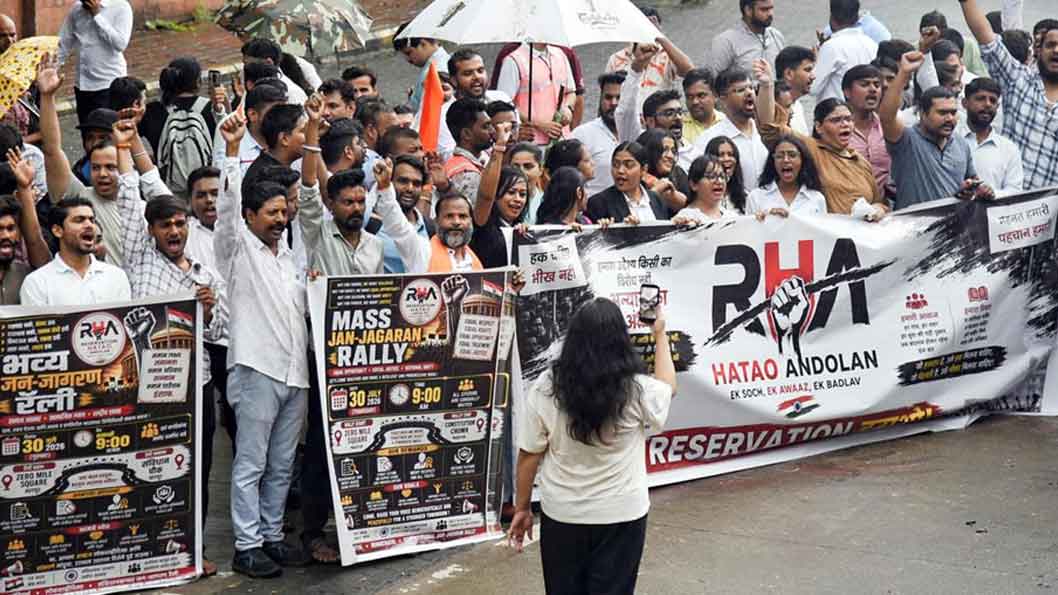
It is cruel occurrence that a slogan outlives the movement that gave birth to it. On 21 August, several hundred protestors gathered at Jantar Mantar under saffron flags, chanting “Educate, Agitate, Organise”, three words coined by B. R. Ambedkar for a struggle against precisely the hierarchy these protestors had come out to defend (Ambedkar, 1992). That afternoon, the Reservation Hatao Andolan (a protest urging the abolition), born on Instagram and now leading 5.6 million followers into the street (Tewari, 2026), made five demands: merit over caste, equal fees, equal age limit, equal cutoff, and move toward economic criteria (Outlook News Desk, 2026).
It is not the first of such afternoons. 1990 had one, 2006 had one, 2016 had two, in Haryana and in Gujarat, and Maharashtra has barely stopped having one since then. Each time, the reservation is a visible object of the crowd’s fury. The foundation of that anger is something else. Something which never occupies a place on the placard, has no face, caste or name that you can stitch on a flag.
This void is not to be ignored but to be placed at the center. The standard diagnoses; false consciousness, WhatsApp radicalization, upper-caste entitlement masquerading as merit, all share a quiet, comfortable assumption. That the protester has simply been duped, and that the right pamphlet, handed out at the right moment, might undo him. No, it won’t. What is needed is not a better pamphlet but a better theory of why the pamphlet fails, and Marx, of all people, provides one, though not the Marx of slogans. The Marx of the first chapter of Capital, on the fetish character of the commodity, where the fault line runs not through anyone’s understanding but through the form of the situation itself (Marx, 1867).
What the Crisis Looks Like and What it Wears?
Start with the bones of it, unglamorous and undeniable. Public employment has been shrinking for three decades, and the number of degree holders seeking it has multiplied. Market forces have steadily taken over higher education; capitation fees, private colleges, a credentialing-based economy that produces graduates faster than it produces jobs. As formal employment has begun to dry up, wealth has flowed upward with the same rhythm. That is the true weather of the Reservation Hatao Andolan: not caste, but a lengthy retreat of capital from the business of giving anyone a secure place to stand.
But look again at the five demands, and see what is not in any of them. Nobody is asking the state to hire more people. No one is calling for a cap on fees, or for holding private colleges accountable for what they charge, or for the restoration of the formal-sector job to something resembling the modest abundance it once offered. All the demands are on the basis on which this already shrunken pool is divided, who competes with who, on what terms, for what remains. This is a real crisis, and not the cause. Something has happened to make the second fact invisible to those very people who suffer the first, and that something has a name older than any of us: fetishism.
The Seat as a Commodity
Marx’s insight was never that people are fooled about value; it is that value, under a commodity economy, has no possibility of appearing except as a property of things. The form of exchange compels a social relation between producers to appear as a relation between things, as if the coat and the linen were haggling with each other, not the people who made them (Marx, 1867). And it can happen without anyone needing to be lied to. The disguise is part of the grammar of the transaction.
Take this to the examination hall; the cut-off list, the interview room, and the mechanism works the same. The insecurity of the job is a social relation, the solidified result of decisions about public expenditure, about which industries are subsidized and which are left to die, about who profits when a university becomes a business. But within the framework of one entrance examination, that social relation can only be articulated as this candidate against that candidate; this caste category against that. The mirage is born from the structure of the contest, not the intelligence of the contestants. Reservation becomes a fetishized object of resentment because the very form of competition for a vanishing seat does not allow the abstraction that is really responsible to show its face. The social relation fades away behind the immediate object.
Knowing Better and Doing it Anyway
That’s why the fetish outlives its own deception. Show a protester the dominance of general category candidates in the top ranks of most competitive examinations. Show him that the collapse of secure employment has much more to do with private sector hiring fleeing than any quota. More often than not, the anger does not shift an inch. Slavoj Žižek names this well: fetishistic disavowal, I know very well that reservation is not really the cause, but still, I act as if it is (Žižek 1989). The disavowal is not a belief that can be reasoned out. It exists in the doing: in the flag waving, the slogan shouting, the petition writing. And deeds, unlike beliefs, are not undone by facts.
A Faceless Crisis and the Face it is Given
It is the final step that makes this a diagnosis of error, as opposed to an account of reactionary politics per se. Moishe Postone, writing about a completely different history, described how an abstract, nameless form of domination, one that cannot be marched against, photographed, or put on trial, gets personified: imposed onto a discernible, identifiable group, so that the outrage the crisis unleashes can locate somewhere solid to land, while the abstraction itself strolls away unharmed, sometimes even safeguarded by the very people it has destroyed (Postone, 1986). Borrow not the misery of the argument here, nor its history, only its shape, and the Reservation Hatao Andolan is almost too apparent. Its own genealogy affirms it: the movement was born out of recent Gen Z protests against irregularities in the NEET examination, a rebellion against a faceless, genuinely abstract failure of the state, and within weeks, the object had shifted from the examination system to caste, from the invisible cause to the visible neighbour. The predicament did not alter-just its face. Further, the face it acquired, in a final, almost unbearable irony, was partly built from Ambedkar’s own words, the language of a tradition that first identified the structural harm correctly, now worn by the movement that demands it be unbandaged.
What this isn’t?
Importantly, such reactionary politics ignore the fact that the reservation was never meant to be a poverty-alleviation scheme. It however did play a huge role in it, because most people who are below the poverty line come from the Bahujan fold. Reservation is meant for providing adequate representation to the people who have been denied in the past, something which is not alien to other parts of the world as well. What we are witnessing is nothing short of distraction from the material concerns. This is not a reform of the redistributive device. It is the instrument, personified, made to answer for a crisis of which it is not the author and which it cannot resolve. The seats just keep vanishing. The ghost responsible changes his coat every decade or so, but he is never, in the end, the one who took the seat away.
References
Ambedkar, B.R.A. (1992). Dr. Babasaheb Ambedkar, writings and speeches: The Buddha and his Dhamma. Dr. Ambedkar Foundation.
Marx, K. (1867). Capital. Verlag von Otto Meisner.
Outlook News Desk (2026). ‘Reservation hatao’ Andolan at Jantar Mantar: Here’s what the agitators demand. [online] Outlook India. Available at: https://www.outlookindia.com/national/reservation-hatao-andolan-demand-economic-criteria-over-caste-quotas-at-jmm [Accessed 24 Aug. 2026].
Postone, M. (1986). Anti-semitism and national socialism: Notes on the German reaction to holocaust. [online] libcom.org. Available at: https://libcom.org/article/anti-semitism-and-national-socialism-notes-german-reaction-holocaust [Accessed 25 Aug. 2026].
Tewari, S. (2026). ‘Rich don’t need quota’: Another protest rising at Jantar Mantar, this time against caste-based reservation. [online] ThePrint. Available at: https://theprint.in/india/rich-dont-need-quota-another-protest-rising-at-jantar-mantar-this-time-against-caste-based-reservation/3021627/ [Accessed 24 Aug. 2026].
Žižek, S. (1989). The sublime object of ideology. Verso.
Harsh Yadav is a Doctoral Candidate at Shiv Nadar University, Delhi-NCR. His research areas are Critical International Political Economy and Critical IR and works on theories of Imperialism.
Image source: ANI / The Hindu