
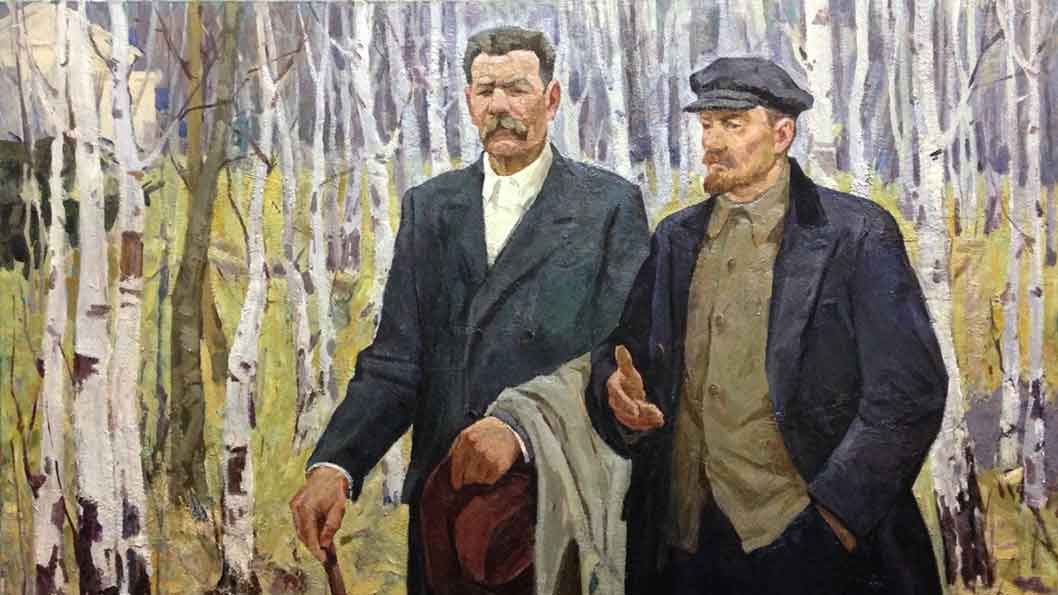
In 1913, Lenin wrote a letter to Maxim Gorky so uncharacteristically vicious that it reads less like party correspondence and more like an exorcism. Gorky had been hobnobbing with Bogdanov, Lunacharsky, and the “god-building” trend, bogostroitel’stvo, the idea, half-humorous and half-messianic, that socialism need not destroy religious feeling so much as redirect it. Let humanity make its own God: not a transcendent tyrant who came down from Sinai, but labour itself, made into an object of worship, a “humanity-God” that the working class would not consider anything but itself, socialised and whole. Gorky liked it, but Lenin did not. “Every religious idea, every conception of god, was unutterable vileness…of the most dangerous kind, ‘contagion’ of the most abominable kind,” he wrote. What made god-building worse than ordinary religion wasn’t that it kept God, in his view. It’s that it preserved the structure of God, a positivized totality, a whole in which humanity could see itself fully, adequately, without remainder, but clothed that structure in the vocabulary of materialism, which made it much more difficult to detect, and thus much more dangerous.
This is not a footnote to the history of Bolshevik factionalism. That is what Lenin is doing, a century early and with none of the apparatus, exactly what Lorenzo Chiesa does in a dense book of Lacanian formalism, The Not-Two: identifying and refusing what Lacan called the “God hypothesis.” For Chiesa, the god hypothesis is not a claim that there is a god. It is a structural temptation inherent in any symbolic system, the temptation to posit, at the point where the system is not closed on itself, a One that would close it. Language, sexuation, cosmology: when there is an internal incompleteness, a “not-all,” there is a pressure to imagine a totalizing figure that would resolve it from outside, even and particularly when we know better than to call that figure God. Its atheism does not destroy the hypothesis. It just changes its clothes.
In the Gorky letters, Lenin instinctively rejects the hypothesis out of hand. In Materialism and Empirio-Criticism his target was the philosophical cousins of god-building, which is Machism, empirio-criticism, anything which allowed matter to shade into something knowable as a completed whole rather than an inexhaustible process encountered piecemeal, through practice, always partially. For Chiesa, Lenin’s materialism is a “not-One” position, held with real discipline: there is no totality on offer, only an asymptotic approach to a reality that outpaces any theory’s claim to have finally grasped it. Not communion but approximation. It’s a kind of ascetic epistemology and it’s no coincidence that it led to a furious rejection, in the same decade, of any comrade who wanted socialism to feel like a religion instead of a science.
This is why the events that transpire in Georg Lukács’s History and Class Consciousness ten years later are so remarkable. Lukacs wrote as a Leninist. The book is awash in the vocabulary of party, praxis and revolutionary consciousness, and he intended it as a continuation of bolshevik theory into philosophy. But its central proposition is that the proletariat can become the “identical subject-object of history”: the point in the social totality where the totality becomes evident to itself, where the object of knowledge and the knowing subject overlap. Lukács shares the bourgeois predicament of being doomed to antinomy, of oscillating forever between fact and value, subject and object, freedom and necessity, as it cannot take any position that comprehends the whole. The proletariat can because its status in production makes it both the object as well as the potential subject of the capitalist totality. By gaining class consciousness it does not simply know capitalism better, it closes the gap between knower and known that has haunted philosophy since Kant.
Go back and read that claim through Chiesa and it no longer reads as dialectical sophistication but as Bogdanov with better footnotes. The proletariat’s “not-One” being, its structural non-identity with bourgeois society, its place as the class that is at once within the system and constitutively excluded from its promises, is not left as an open wound, an incompleteness to be lived with. It becomes the promise of a future One: the subject which at the moment of revolutionary self-consciousness will realise precisely the totalised self-transparency that Lenin’s epistemology in principle condemned. This is why the Comintern moved so quickly against the book in 1924, and why Lukács himself, in a preface written decades later, disavowed its “messianic utopianism.” The rebuke was not really about a lack of materialism. It was the theology, that was stinking to all.
Chiesa provides us with a method of viewing this as a true undecidability rather than an error that needs to be fixed, something that neither Lenin nor Lukács have the vocabulary for. His own reading of the God hypothesis in Lacan is not “totality is always ideology, always refuse it”, that would be just stating the Lenin position. Indeed, Chiesa points out, incompleteness itself tends to generate its own paradoxical One: not the vulgar totality of naive metaphysics, but a “materialist theology” in which the not-One, the gap or lack itself, starts to function as a sort of structural absolute, Žižek’s move more or less, reading the drive’s very failure to achieve satisfaction as itself a positive ontological principle. Chiesa refuses to choose between this and the more hard-line, purely negative reading. The result, he says, is “materialist agnosticism,” which he insists is not a cop-out but the honest terminus of inquiry.
That agnosticism is precisely what is lacking in, and precisely what is required in, the space between Lenin and Lukács. Lenin’s refusal is bracing, but it struggles, on its own terms, to account for where revolutionary agency comes from at all, if there is no perspective from which the totality becomes discernible, what grounds the confidence that revolution is anything other than one more approximation, forever deferred? Lukács’s totality solves that problem by cheating: it smuggles back precisely the completed self-knowledge that Lenin spent a career attacking, and it clothes it in the very “scientific” language that was supposed to have exorcised it. Neither position, by itself, withstands the best objection of the other. What remains is the tension between them, not a defect in Marxist theory, but, on Chiesa’s reading, the honest form of any theory that must think a totality that it is also, inescapably, within.
This is not an academic triviality. Every serious attempt to think of capitalism “as a whole”, every claim that critique has finally found the point from which the system can be fully legible, whether that is the party, the proletariat, a science of value, or a philosophy of history, risks performing Lukács’s move quietly, to become a new god-building dressed in the strictest scholarly vocabulary of the last century. And every refusal to make that claim, every insistence on being at the level of partial, provisional, always-incomplete critique, risks Lenin’s opposite problem: an epistemological modesty so consistent it can no longer say what would ever justify acting as though the whole could be changed. Marxism never really answered this. It has just sometimes forgotten that it was ever a live question, which is its own way of letting the God hypothesis back in through the service entrance.
Harsh Yadav is a Doctoral Candidate at Shiv Nadar University, Delhi-NCR. His research areas are Critical International Political Economy and Critical IR and works on theories of Imperialism.
Image – “Conversation: VI Lenin and Maxim Gorky” – 1970 By Artist: Yudenko Ivan Savelyevich