
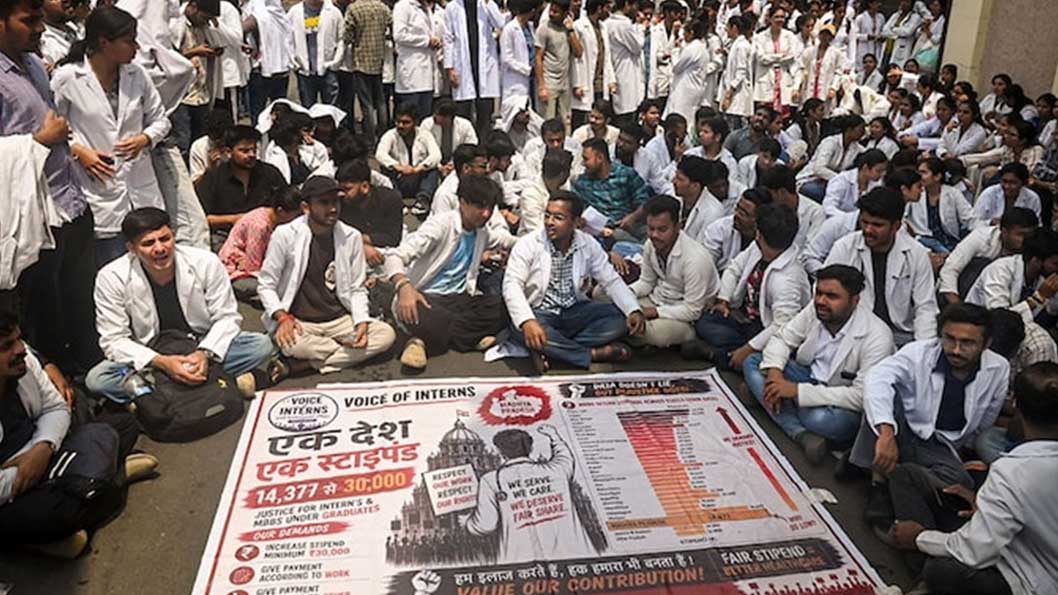
The White Coat on the Road
On the morning of 7 September 2026, a group of medical interns in their white coats and aprons marched from Gandhi Medical College towards the Chief Minister’s residence in Bhopal, Madhya Pradesh, India, with a demand for an increase in stipend from ₹14,337 to ₹30,000. They failed to advance beyond Hamidia Hospital because the state machinery was waiting for them. Police barricades had been placed, water cannons opened, and lathis charged. Videos and reports about young doctors in white coats getting drenched on the road spread quickly throughout the country. The image was troubling. The white coat is understood as a sign of expertise and social respectability, but this time it was on the streets demanding more than respect, i.e., a better payment from the state for their services.
Ultimately, the Madhya Pradesh government agreed to a 50 percent increase, bringing the stipend to ₹21,500. However, the demand for similar raises began to echo beyond Bhopal. Medical interns and young doctors in other parts of India, such as Khandwa (Madhya Pradesh), Rajouri (Jammu & Kashmir), Rajnandgaon (Chhattisgarh), Lucknow and Prayagraj (Uttar Pradesh), and Rajasthan FMGs [1], raised similar questions regarding stipend, working conditions, and payment flow. In various states, the amounts were different, however, the question started appearing eerily similar, i.e., the same long working hours, same overcrowded public hospitals, same reliance on state institutions, and very distinct amounts of stipends. This brings us to a question that is beyond the immediate demand for an increase in the stipend. The question is not only why the interns are demanding more money. It is more than that; it is about what happens when people who have spent years achieving the status of healthcare professionals negotiate with the government over the value of their work. In the middle of the protest, a Hindi slogan that began to circulate alongside footage of medical students, soaked by water cannons, sitting huddled together on the wet road, captures this contradiction.
“Safed coat wala bhi jab sadak pe baith jaye, toh samjho system beemar hai.”
(“When even those in white coats are sitting on the road, you know the system is sick.”)
What Exactly Is an Intern?
In a post-colonial state like India, where the medical profession is viewed as a noble one, there is an unspoken expectation that doctors will serve, help, and even sacrifice greatly in their work. The doctors become something like demi-gods. Nonetheless, medical practice, endowed with the prestige of nobility and ethics, serves as a moral justification for a mode of labour exploitation in the name of service and training. And this reification [2] is reinforced by legal and administrative entities by classifying full-time care providers as students, trainees, or interns. And this leads to confrontation with an uncomfortable question. Who exactly is an intern? Are they a student, a trainee, a future doctor, or a worker?
Medical Interns are considered students, as they are learning, supervised, and completing a compulsory stage of professional training. However, they also run the hospital’s day-to-day operations, including managing emergency wards, working night shifts, performing essential procedures, handling overcrowded wards, and handling administrative paperwork. Perhaps this is where the question of the white coat becomes interesting. It is not simply a piece of clothing, as it also carries a social meaning. It allows the person wearing it to appear first as a doctor and only afterwards as a worker. But the case of interns is totally opposite, as they are in a liminal space, where the material conditions of their labour can become strangely invisible behind the symbolic status of the profession. And ultimately, this white coat becomes a fetish object, and under the guise of pedagogy, the state converts extremely long working weeks into a stipend.
One Nation, Unequal Stipend
The protests will be difficult to understand if the stipend is treated simply as a number. An MBBS intern in one state can receive substantially more than an intern performing similar duties in another. Assam is already paying around ₹35,000, and Tamil Nadu is paying between ₹25,000 and ₹27,300 [3]. While Jammu and Kashmir interns were seeking a rise from ₹12,300 to ₹30,000. Madhya Pradesh interns sought an increase from ₹14,337 to ₹30,000 and ultimately received a 50 percent hike. Uttar Pradesh moved from ₹12,000 to ₹25,000, Bihar from ₹20,000 to ₹27,000, and Uttarakhand from ₹17,000 to ₹25,000 [4, 5]. This intrigued me with the question of why one state government pays more than another. Why does the same category of medical labour acquire such different economic values depending on where it is performed? And upon pondering, I come up with a very uncomfortable phrase: stipend apartheid. Here, it is not about the system of racial segregation, but a system in which comparable categories of medical trainees are differentially valued through state and geography-specific arrangements of remuneration. The difference is not produced by the work itself alone. It is produced by the institutional location in which that work takes place. In private medical colleges in UP, they were even deducting Rs 2,000 from the amount payable to interns [6]. And the National Medical Commission’s regulatory framework does not establish a single uniform stipend across all states, leading to disparities in intern remuneration. It is very paradoxical that the significance of the white coat, which is national, traverses easily across state borders, whereas its stipend does not. When the medical curriculum is national, professional identity is national, patients’ need for care is national, but the valuation of the intern’s labour remains deeply uneven.
From Hegemony to Coercion: The Refusal of Unfree Labour
It may be tempting to view the question of stipends as a purely economic concern, but to better understand it, we must consider it within the broader political economy of healthcare in India. In this country, public health has long operated in a climate of low public expenditures. According to the data released in May 2026 on the National Health Account of the Indian Government provided by the Union Health Ministry, government expenditure was 1.43 per cent of the GDP in India in 2022-23. Here, my point is not that this single statistic explains all the events in the hospitals. It cannot do this, of course. However, statistics do reflect certain aspects of the material conditions under which healthcare should function. When the system is supposed to function efficiently under constant fiscal constraints, the costs of those constraints do not simply disappear. They get absorbed somewhere. Sometimes they find expression through the shortage of personnel. Sometimes, they manifest as contractual or temporary employment due to an overcrowded ward or long working hours. And sometimes, perhaps, as a medical intern working through the night for a stipend that barely reflects the work being performed. In Antonio Gramsci’s Prison Notebooks, he wrote that when a ruling order loses the consent of the people, it resorts to using force [7]. This shift, which Gramsci points out in his works, is evident in the Bhopal incident. However, it would be incorrect to conclude that Bhopal was an isolated case. When medical interns opposed the notion of ‘sacrificed duty’ and demanded parity in pay, the government did not hesitate to use the Repressive State Apparatus [8] by firing water cannons and deploying riot police.
In the middle of the protest, one slogan caught my attention: “We are doctors, not criminals.” I find it very intriguing because it assumes that being a doctor should matter in how the state responds to you. Quite an interesting assumption. However, what happens when an individual in a white coat no longer enjoys safeguards against being viewed as a protester? This situation raises an important issue of the link between professional legitimacy and political power. While the state may praise medical professionals and consider them important contributors to the functioning of the healthcare system. However, when these professionals resist the system’s terms, their professional identity does not necessarily insulate them from coercion. The language of service can work as long as it remains a language of obligation. The difficulty begins when those expected to serve ask what they are owed in return.
A Crisis of the State, Not the Ward
The protests by medical interns and junior doctors in India reflect their pragmatic solidarity [9]. Leaving the OPD, mobilizing across states, and raising their voice in the streets means that these young professionals are resisting and rejecting the role of passive shock absorber. They are showing the contradiction of the state under late capitalism because the latter pretends to have modern public facilities, yet fails to invest in social reproduction. When health workers must endure being beaten by water cannons in order to get enough money to stay alive, the crisis has moved beyond the hospital wards. It is now the state’s crisis. The issue raised here should not be reduced to a question of a rise in stipends. It is a question of what kind of healthcare system is created, in which those who provide day-to-day care must step out of the hospital, put on their white coats as a symbol of protest, and occupy the road before their labor becomes visible. Perhaps the most revealing image is not the white coat inside the hospital, but the white coat outside it. What does it mean for the future of public healthcare when the people expected to sustain collective life must first struggle to sustain themselves?
References
[1] Saha, A. (2026, September 16). Rajasthan FMGs on protest at DME demanding internship stipend. Medical Dialogues. https://medicaldialogues.in/state-news/rajasthan/rajasthan-fmgs-on-protest-at-dme-demanding-internship-stipend-179335
[2] Lukács, György. History and Class Consciousness: Studies in Marxist Dialectics. Translated by Rodney Livingstone. London: Merlin Press, 1971. (See specifically the central essay, “Reification and the Consciousness of the Proletariat,” pp. 83–222).
[3] King, S. (2025, May 14). States in India offering the Highest Internship Stipend in MBBS. EducationTimes. https://www.educationtimes.com/webstories/states-in-india-offering-the-highest-internship-stipend-in-mbbs
[4] Mishra A. Low stipends, long duties: medical intern protest highlights stark stipend gap across states. Medical Dialogues [Internet]. 2026 Sep 14; Available from: https://medicaldialogues.in/mdtv/healthshorts/low-stipends-long-duties-medical-intern-protest-highlights-stark-stipend-gap-across-states-179202
[5] Bhat R. MBBS interns across states battle disparity in stipends amid lack of uniform national policy. The Times of India [Internet]. 2026 Sep 14; Available from: https://www.educationtimes.com/learning/mbbs-interns-across-states-battle-disparity-in-stipends-amid-lack-of-uniform-national-policy/articleshow/134179561.cms
[6] Shukla S. UP private medical college students on hunger strike, seek clarity on Rs 25,000 hike in MBBS interns’ stipend. Careers360 [Internet]. 2026 Sep 11; Available from: https://news.careers360.com/up-private-medical-college-students-hunger-strike-seek-clarity-rs-25000-hike-in-mbbs-bds-internship-stipend-govt-udf-doctors-group?utm_source=gemini
[7] Gramsci, Antonio. Selections from the Prison Notebooks. Edited and translated by Quintin Hoare and Geoffrey Nowell-Smith. London: Lawrence & Wishart / New York: International Publishers, 1971, pp. 275–276.
[8] Althusser, Louis. “Ideology and Ideological State Apparatuses (Notes towards an Investigation).” In Lenin and Philosophy and Other Essays, translated by Ben Brewster, 127–186. New York / London: Monthly Review Press, 1971.
[9] Farmer, Paul. Pathologies of Power: Health, Human Rights, and the New War on the Poor. Berkeley: University of California Press, 2003.
Keshav Sawarn is a PhD scholar in Sociology. His research explores structural violence and the political economy of healthcare, focusing on the social determinants of health in India.
Image source: India Today