
By Shiran Illanperuma
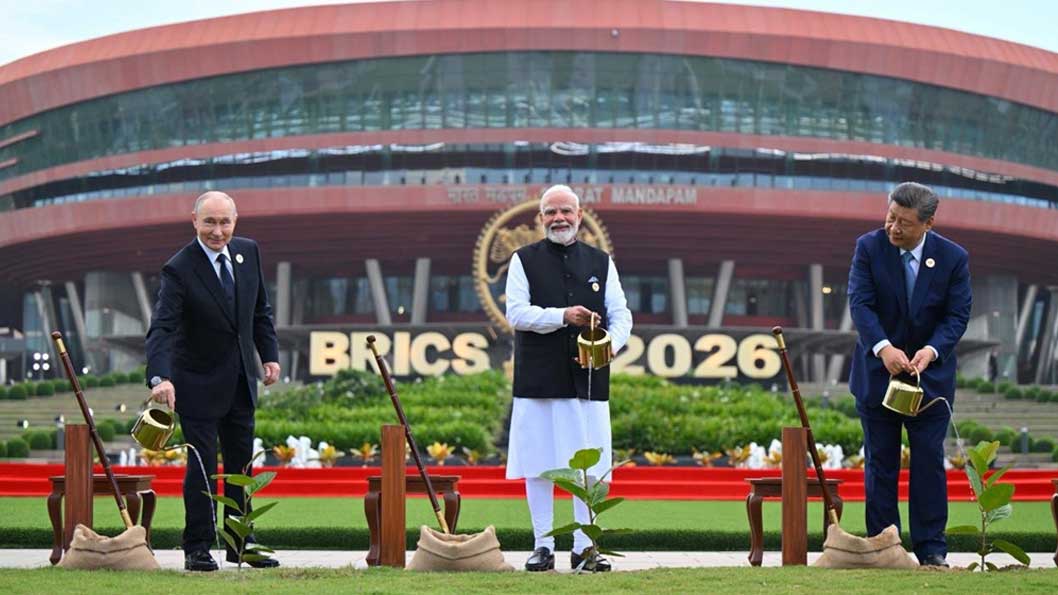
The BRICS New Delhi Declaration, an outcome of the eighteenth BRICS summit held under the rotating chairship of India, called for a more democratic global order and alternative payment systems. Yet months earlier, in July, India itself had purchased a record net $15.2 billion in US treasuries. The contradiction highlights the ambiguities of the BRICS process, and India’s – and by extension South Asia’s – place within it.
In 2009, in the wake of the Global Financial Crisis, four of the largest countries representing the global majority met in Yekaterinburg, Russia. The acronym for this grouping was BRIC – after the members Brazil, Russia, India, and China – and would expand to BRICS with the addition of South Africa in 2010.
In the decade and a half since, the BRICS process has renewed conversation about multilateralism and democratising the international order. The process has expanded to include ten full members and thirteen partner countries. While these additions have begun to fill out the map of the Global South, the subregion of South Asia remains underrepresented. Founding-member India has pursued strategic alignment with the United States and Israel, while no new members from the region have joined BRICS.
Asia’s Blind Spot
The shifting of the centre of gravity of the global economy to Asia, especially in the wake of the Global Financial Crisis and third long depression, is the motor of the BRICS process. While the BRICS share of global income has surpassed that of the G7, this is largely a function of China’s industrialisation. Nonetheless, West Asia, Southeast Asia, and Central Asia remain strategically important subregions for BRICS expansion and legitimacy.
In West Asia, the addition of Iran and the United Arab Emirates (UAE), as well as closer cooperation with Saudi Arabia and Bahrain, adds greater representation to a subregion at the crossroads of energy, finance, and security. For Central Asia, the addition of Shanghai Cooperation Organisation (SCO) members Kazakhstan and Uzbekistan as partner countries brings in the Eurasian heartland. For Southeast Asia, the addition of Indonesia (the fourth most populous country in the world) as a full member and major export manufacturers Malaysia, Thailand, and Vietnam as partner countries provides representation for one of the most economically dynamic subregions in the world.
But while West, Central, and Southeast Asia advance in shaping the BRICS process, South Asia remains largely absent despite India being a founding member and host of the eighteenth summit recently concluded in Delhi. Pakistan applied for membership in 2023 but has not advanced, likely due to opposition from India. Notably, three countries that have faced great political upheaval in the past few years – Sri Lanka, Bangladesh, and Nepal – were absent from the Delhi summit.
South Asia Divided
South Asia is one of the least economically integrated regions in the world. Though the centre of gravity of the world economy is shifting to Asia, this shift is tilted towards the northern and southeastern parts of Asia. With China increasingly at the centre, North and Southeast Asia form an integrated productive circuit producing the majority of the world’s manufactures. India-centred South Asia has its own unique dynamics that require unpacking.
First, South Asia is rife with unresolved border disputes – ticking time bombs that are a legacy of British colonialism. There are border disputes between India–Pakistan, India–Nepal, India–Bangladesh, India–Sri Lanka (largely in the maritime domain, over the island of Katchatheevu and the continental shelf), and Afghanistan–Pakistan. These border issues are often more perceived than real, providing fodder for domestic political posturing – especially before elections. Nonetheless, these disputes have the effect of increasing suspicion across borders.
Second, South Asia has made very little progress in industrialisation relative to the rest of Asia. Most of the region has never undergone thorough land reforms, with vestiges of non-capitalist relations holding back development. Without industrialisation, there is very little impetus for the geographic overflow of industrial supply chains that leads to greater intraregional trade and investment of the kind observed in North and Southeast Asia. In short, South Asia does not trade within itself because it produces very little that is tradable – and it is that lack of economic integration that reinforces political fragmentation.
Third, and following from the second point, South Asia’s greatest export is its surplus labour. Since an unresolved agrarian question and lack of industrial development limit the capacity of the economy to absorb employment, the region requires emigration as a ‘pressure valve’ for high levels of unemployment. Much of this labour is destined towards the Persian Gulf countries and the Global North. The resulting structural unemployment question – especially high youth unemployment – is the principal motor behind what the mainstream media labels the Gen Z phenomenon, which is best understood in class rather than generational terms.
Gen Z Without Borders
Sri Lanka, Bangladesh, and Nepal have faced consecutive youth-led mass protests that led to the toppling of governments. This ‘South Asian Spring’ came against the backdrop of heightened economic distress in the wake of the COVID-19 pandemic and Russia–Ukraine conflicts. In all cases, some combination of high youth unemployment, high external debt, and high inflation played a role. However, the dynamics and outcomes of these protests were largely contingent on domestic variables.
In Sri Lanka, voters rejected the traditional parties and brought to power an electoral front led by the left-wing Janatha Vimukthi Peramuna (JVP, People’s Liberation Front), which campaigned on an anti-corruption platform. In Bangladesh, Prime Minister Sheikh Hasina went into exile and her party was banned from contesting the elections, allowing the centre-right Bangladesh Nationalist Party (BNP) to take power, and the far-right Jamaat-e-Islami to emerge as the opposition. In Nepal, the communists were electorally decimated and an entirely new centre-right political formation, the Rastriya Swatantra Party, led by rapper-turned-politician Balendra Shah, took power.
Since their political transformation, all three countries have pursued markedly conservative foreign policies. Sri Lanka has signed key defence agreements with both India and the United States. Bangladesh has tilted more decisively towards the US, resulting in its relationship with India coming under strain. By contrast, Nepal has become more firmly ensconced within India’s strategic interests.
Bangladesh was invited to the BRICS Delhi summit but did not attend due to its strained relations with India. What is more interesting, however, is the fact that neither Nepal nor Sri Lanka was invited, despite both countries growing closer to India after their political transformations. Sri Lanka in particular had formally applied to join BRICS in 2024. There appears to be little evidence of either the Sri Lankan or Nepali administrations showing strong interest in joining the BRICS process.
Ostensibly, it is these smaller countries, caught in the vagaries of debt and climate crisis, that would benefit the most from the diplomatic space provided by the BRICS process. But their absence, and seeming lack of initiative to join the process, paints a complex picture of the limits of recent political transformations in the region.
Finally, and perhaps most decisive, is the fact that the aggressive and erratic behaviour of US hyper-imperialism – manifest in tariff wars and the pursuit of bilateral military partnerships – creates disincentives for fragile economies like Sri Lanka, Bangladesh, and Nepal to dare entry into the BRICS formation, let alone use it as a forum to advance multilateralism.
India’s Wavering Foreign Policy
India’s dual role in both the BRICS and US geostrategic alliances like the Quadrilateral Security Dialogue (Quad) looms large in understanding South Asia’s place in the BRICS process.
Under Prime Minister Narendra Modi and the Bharatiya Janata Party (BJP), India has drifted away from several key foreign policy pillars that have been thoroughly exhibited since its independence. India has deepened its ties to the United States and Israel, moved away from Iran, and failed to condemn the illegal sinking of an unarmed Iranian vessel in the Indian Ocean.
The rightward drift of Indian foreign policy cannot but influence the rest of the region, especially as Indian capital, as a junior partner of US imperialism, itself seeks to expand across the region and keep out Chinese investment. Indeed, Indian capital may even prefer to subordinate the foreign policy of its smaller neighbours to its own interests rather than to encourage their entry into broader multilateral platforms.
The South Asia-shaped hole in BRICS is a complex interplay of local class dynamics, regional contradictions, and the threats and limitations imposed by US hyper-imperialism which seeks to fragment and divide opposition, weaponising bilateral dealmaking to facilitate unilateral decision-making. The South Asia case demonstrates that governments and states alone cannot advance a project of democratising the global order, and that social movements must mature to a point of contesting power in the international order.
Shiran Illanperuma is a Sri Lankan journalist and political economist. He is a researcher at Tricontinental: Institute for Social Research and a co-editor of Wenhua Zongheng: A Journal of Contemporary Chinese Thought. He is a visiting lecturer at Bandaranaike Centre for International Studies.
Image Source: Bureaucracy India