
‘We need to create sober, patient people, who do not despair in the face of the worst horror and who do not get excited about every little thing. Pessimism of the intellect, optimism of the will.’
Those very lines Antonio Gramsci wrote, kept repeating in my head every time I heard a new headline about the Cockroaches protest that was progressing in Jantar Mantar. For anyone who has been a keen observer of the political slumber in the country, there were enough reasons to be pessimistic about it. I myself had the privilege of being detained by the state police and being thrown into a detainment bus while protesting the 2024 paper leak by the same national testing agency in the country that has been exposed for its failures by the current movement. It was a small group back then (imagine my shock at seeing the numbers who had assembled during the parliament march), comprised of student activists and left-wing organisations who had gathered outside the Ministry of Education, 2 years from the week that shook the nation awake to a new reality of political organizing.
Till the kidnapping of Sonam Wangchuk, the momentum of the hunger strike and the Cockroach Janata Party(CJP) movement seemed like it was slowly building. However, as others have pointed out, this kidnapping by the State made the layman feel as if his dignity was stolen in broad daylight on national television. That gave the sudden impulse that was needed for a spontaneous burst of anger for answers and accountability.
The founder of the CJP movement who belongs to a Dalit identity, had from the beginning unapologetically invoked the slogan of “Jai Bhim!”, a valiant cry for social justice first given in commemoration of Father of the Indian Constitution, Dr Ambedkar. Till recently the slogan“Jai Bhim!” had been mostly used by progressive forces and Dalit-Ambedkarite Organisations. The difference this time around was the vigour with which the large crowds that assembled had taken it up. There was no hesitation, which was not the case before during protests big and small. The age and demographics of the crowds were so wide the message of the movement had cut across a large section of the population. So was the well-known leftist slogan “Inquilab Zindabad” (long live the revolution). When push came to shove, participants in the movement who were largely independent of the various organisations that were on ground keeping it lively, took up these very slogans themselves and the messages carried by the very images of Che Guevara, Bhagat Singh and Dr Ambedkar.
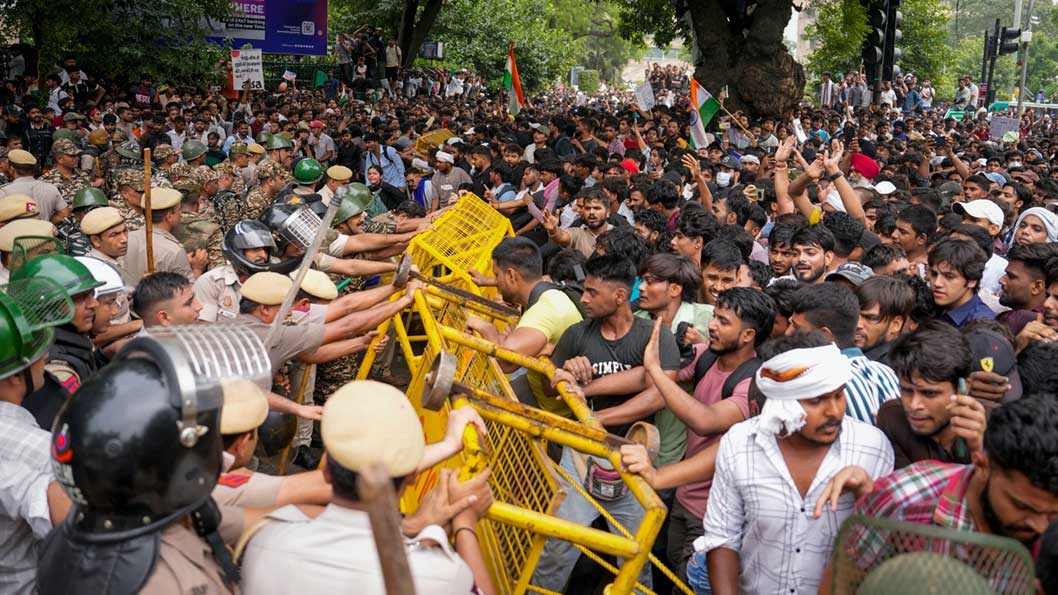
As it has already been acknowledged by many, the left organisations in the core of Jantar Mantar protest provided substance and imagination to the people who had gathered. Similarly, on the day of the parliament march the huge number of young and old that had assembled, showed a level of restraint and non-violence that was so unreal and impossible to be ignored for a movement that lacked a clear leadership or a commanding voice at the forefront. The Cockroach Janata Party (CJP) never offered such leadership even if they intended something as such or not. As one ponders more into it, the ones left to be acknowledged are the various trade unions and mass organisations that brought their members from various parts of Northern India in small but significant numbers to the ‘Parliament March.’ They brought with themselves the slogans and experiences of small but significant struggles they fought during the last decade for basic rights in their villages and towns that never got the visibility or attention as those that happen in cities. It added a level of diversity and sophistication to the crowds that were occupying the boulevard leading to the parliament. Another major force that brought all its vigour was the Bhim Army[1], an Ambedkarite organisation, which mobilised under the leadership of Chandrashekhar Azad, bringing in scores of Ambedkarites in large groups which kept flowing into the Central Delhi streets occupying traffic signals and the footpaths leading towards Jantar Mantar.
The various visuals of the parliament march being met with force by the state has been widely watched and at present have been at the receiving end of censorship by Meta over the advice of the Union Government. Here I would like to jump directly from the episodes of state repression against parliament march and share a few testimonies of persons I meet in the days following the ‘Parliament march.’ The brute force with which the youngsters were dealt with, further added fuel to the anger and frustration. People of all ages started flowing into Jantar Mantar from all bordering states of the capital city, ordinary people from all walks of life who have suffered enough from the economic failures, precarity of the present and those who saw a bleak future for their dreams. The movement for the resignation of the Education Minister had gone beyond its demands as Prof. Apoorvanand had put it[2]. It is over the course of these next few days that I get to meet two 18 year olds, a middle aged man from Haryana and a group of school children from Sangam Vihar that I would like to share here.
G, an 18 year old from Kerala made his travel of 3000+ kilometres to the epicentre of the protest. It came to my knowledge that he did not make arrangements for an accommodation nor had he told his mother. Even though a little naive he was confident on being able to make the journey braving the painsome hours and discomforts of an Indian railways general compartment. Then during a walk to the Sansad Marg which hosted the overflowing crowds from the limits of the Jantar Mantar epicentre, a 30 something old man sat next to me to take a break and eat some rice and curry which was served by another man, a local, who took the effort to contribute to the movement in ways possible to him. The tired soul who sat down, started explaining to me how he will never go hungry if he stay here. People kept sending food through online platforms, while local shopkeepers and workers who ran humble street shops in various parts of Delhi brought in whatever food they were able to cook and serve during the in betweens of their everyday toiling. It was on the same street that I met another 18 year old from Bihar who also left his home without telling his parents, who was more articulate about the problems plaguing the education system of our country than a lot of the political veterans who took the main stage of the protest to address the crowd. He was clear that an end to the present regime was the only way out and was stubborn about not leaving until the resignations of the ministers and Prime minister came through. On the day the resignation letter of the minister came, I came across a considerably big group of high school students who made the travel from their school in Sangham Vihar and boarded our bus to the visible dissatisfaction of the ticker checker. Somebody loudly asked where they were travelling to, when one from the group that had got in, hits back in the same volume by shouting that they were headed to Jantar Mantar. Noticing some of the adults murmuring in judgement about them, this young boy again shouted that he was going for their own futures and their next generations too. It was in them that I saw a glimpse of what is to be expected from the immediate future. These audacious teenagers were probably 5-6 year old, when the Modi government and its Hindutva project eclipsed upon India. At the age of 16 or 17 they have not probably seen or been able to take part in a struggle of such scale that has brought people together and their imaginations of a better future as it has happened in this movement that came from an internet joke.
In the immediate week that has followed after the protest in Jantar Mantar has been called off, the government passed an amended bill to an original legislation from 2024 that imposed harder punitive provisions to culprits who engaged in cheating. Yet, this comes to nothing short of putting a bandage for someone having a heart attack as rightly put by Neha Bora, the shining face of the partisan Left in Jantar Mantar. This surely is a situation where the system that keeps repeating the same mistakes have engaged in a PR exercise to save their faces. The National Testing Agency responsible for the public examinations remains registered as a society that owes no accountability or transparency to the public like a regular governmental institutions. The examination centres for these competitive exams get allotted to private computer centre businesses which offer no comfort or sympathies to the aspirants. The system is designed to corrupt itself again. The New Education Policy brought out in 2020 has been a disaster for the students in the country[3]. Much has been talked about the NEP which continues to survive while further alienating the poor and marginalised sections from gaining quality education in the country. It has tried to over-centralise the education sector under the Union government while education as a subject remains a concurrent item in the constitution, giving equal rights to the federal states and union government.
There is also the police department, which has been exposed for its subservience to the ruling classes and its ignorance of constitutional values. The visible marks of injuries on students and youngsters are still fresh. The brutality unleashed live on screen has changed the perspectives of so many people in the country for the first time in their lives. The judiciary, which has shown its disinterest in entertaining petitions against brutality, have also added to the dissatisfaction it already burdens. Let us not forget their pivotal role in bringing this movement alive by remarking the youth as Cockroaches.
After 30 years of economic reforms, public examinations to governmental institutions remain the only credible pathway to social mobility and security against a precarious future. Families sacrifice everything for their children preparing for examinations like the National Eligibility cum Entrance Exam, Common University Entrance Exam tests and similar centralised and state level examinations. Besides these major exams, question paper leaks and corruption have also affected various State level PSC examination in the country[4].
The unemployment rates among urban youth remains 16% as per the Indian governments’ estimate[5]. The youth of India are forced to take up low wage labour in the gig economy, where the entire business model runs on the exploitation of these very gig workers. The past decade has also seen heightened alienation of Muslims, Dalits and every other minority sections. These are the current conditions wherein the distraught people found a platform as that of the CJP.
The Indian youth ranging from 18 to 35 years of age are set to be the biggest voting block in the general elections to the Indian Parliament in 2029. The onslaught of neoliberalism added with no support from the state or the employer, be it in the form of the liberalised labour code introduced in 2020 or the lack of quality job creation in the private sector, the nature of youth employment in the country has worsened. Frustrations over ongoing issues in higher education has cut across the considerations of caste, religion or ethnic minorities producing a situation in which the youth see themselves as cockroaches surviving on the margins of a system that has consistently worked against them. Traditional party politics in the country has also failed to address these frustrations, further deepening their alienation. This vacuum led to the formation of a shallow movement like CJP. While it risks repeating the very patterns of the Anna Andolan movement brought on by the frustrations towards corrupt governance system in India, the leadership of the CJP movement has, for now, outlined a timeline for a nationwide outreach program on education reforms and has proclaimed themselves to remain as an external pressure group. The ripples of the CJP protest in New Delhi will definitely be observed and studied with interest in the immediate future.
Ananthapadmanabhan is an independent researcher in law and a legal practitioner based in Delhi
[1] https://en.wikipedia.org/wiki/Bhim_Army
[2] https://www.aljazeera.com/opinions/2026/7/29/indias-youth-have-broken-modis-spell
[3] https://frontline.thehindu.com/the-nation/nep-education-crisis-india/article71150354.ece
[4] https://www.deccanherald.com/india/jharkhand/explained-why-are-jharkhand-students-protesting-inside-the-jpsc-jssc-recruitment-row-4097090
[5] https://www.dw.com/en/india-high-youth-unemployment-poses-massive-challenge/a-69018952