
Antonio Gramsci’s line from a fascist prison in the early 1930s has been quoted into cliché ever since: the old world is dying, and the new cannot yet be born, and in this interregnum a great variety of morbid symptoms appear. South Asia, in this decade, can be one of the clearest demonstrations of that. Sri Lanka’s Aragalaya in 2022, Bangladesh’s quota reform uprising in 2024, Nepal’s Gen Z movement in 2025, India’s Cockroach Janta Party (CJP) in 2026, and Pakistan’s simmering, still-unignited Gen A discontent are not five unrelated stories; rather, these are the five symptoms of one condition. These movements did not bring forth some new ideological vacuum. The vacuum was here first; it was a good deal older than the last few years.
Each of these states has traces to some version of progressive nationalism; anti-colonial in India and Pakistan, socialist-inflected in Sri Lanka’s early decades, liberation nationalist in Bangladesh, and republican and federalist in Nepal’s 2006-2015 transition. None of this was empty rhetoric. It produced real coalitions and real constitutions. However, this couldn’t translate to the harder thing: ideology was supposed to build independent bureaucracies, judiciaries with their own rulings and enforcement, labour markets capable of integrating a growing population, education system calibrated to the jobs that exist. The founding ideologies outran institutionalization and morphed into slogans. The state continued to function on patronage and improvisation. A generation was born and raised in this. It navigated through a distinct type of reality: hollow growth. GDP continued to rise, cities were expanding, smartphones and newer technologies arrived on schedule. But the institutions that were required to convert the growth into inclusion and opportunities were mostly never built. The uprisings didn’t represent a new rupture, rather it is an old untreated condition finally showing visible symptoms.
A generation fluent in the market, illiterate in the political
These movements were different regionally, but they shared structural similarities. The 2024 uprising of Bangladesh was not about grand ideology. It was mostly driven by essential demands. Almost two million youths entered the job market every year against perhaps 65,000 graduate-level jobs. On top of that, a quota system reserved more than half of the most government positions for the descendants of 1971 freedom fighters and other selected groups.
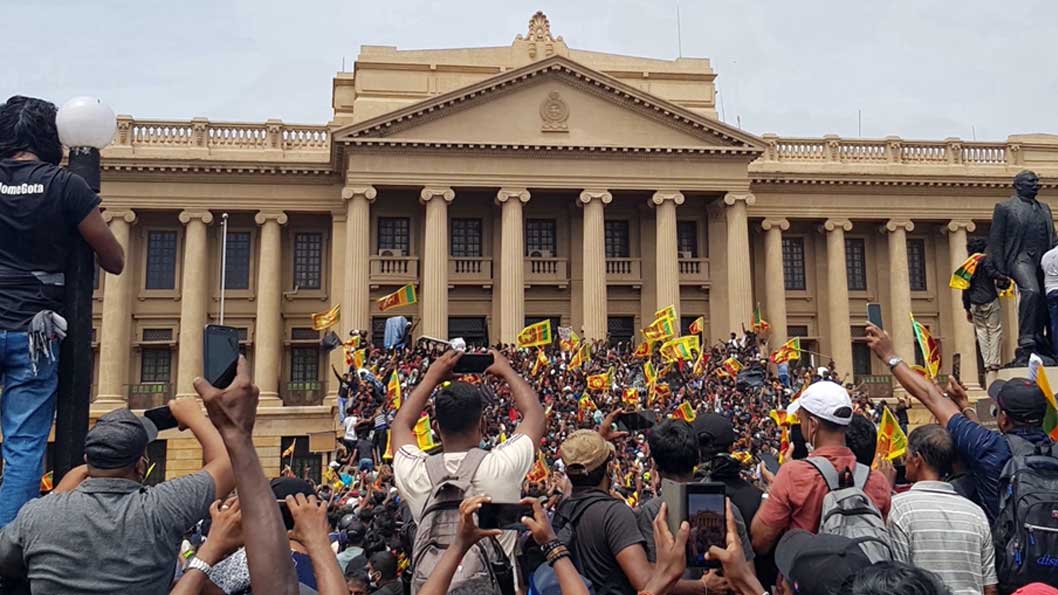
Some 28 percent of graduates were unemployed as of the 2022 Labour Force Survey, and nearly 40 percent of Bangladeshi youth were, by 2024, neither employed, in education, nor in training. In Nepal, youth unemployment sat above 20 percent through 2025, remittances made up roughly a third of GDP, and the September 2025 uprising was lit by a government ban on twenty-six social media platforms — after the “#NepoKids” trend had already turned private envy into public rage. Sri Lanka’s Aragalaya emerged from 2022’s currency collapse, inflation near 70 percent, food inflation near 95 percent, and people who had never protested anything in their lives occupying Galle Face Green under the banner GotaGoHome. India’s CJP, born from Chief Justice Surya Kant comparing unemployed youth to cockroaches, amassed over twenty million Instagram followers within weeks — a movement of coaching-centre students, gig workers, and fresh graduates answering a youth unemployment rate that hit a record 16.2 percent in mid-2026, and research showing barely 3.7 percent of male graduates land genuinely white-collar work. Even Pakistan, where about 60 percent of the population is under thirty, has produced the same raw material without, yet, the same eruption.
These aren’t just grievance statistics; they’re institutional-failure statistics — a quota frozen since 1972 is a bureaucracy that stopped adapting, a youth unemployment rate that keeps climbing even as GDP grows is a labour market that was never built for the schooling system expanding alongside it. The failure shows a different reality. It is not shown by the unemployment statistics but by a simple question. Who do people actually trust? During the failure of the institutions something else fills in the vacuum. For these countries, it was filled by a social media account, a hashtag, a viral statement.
When the account becomes the institution
From the CJP protests in Delhi, the most significant viral detail was not a policy demand. It’s a phrase: “Cameraperson Parth, dikhaiye” (show it). That recurred through journalist Samdish Bhatia’s livestream coverage of the protests. It became a shorthand test of credibility: if the camera hadn’t shown it, it hadn’t quite happened. Additionally, the state suggested most of CJP’s followers were foreign. In response, founder Abhijeet Dipke didn’t wait for a fact-checker. He posted his own analytics within hours, showing roughly 95 percent of followers were Indian. It was a rebuttal no other press council or election commission in the country could have produced on that timeline.
For Bangladesh, the same shift was more starkly. It happened under an active blackout. The government’s five-day internet shutdown in July 2024 was meant to sever the public from any accounts except its own. People instead followed the personal Facebook posts of the movement’s coordinators such as Nahid Islam, Sarjis Alam, and others in the group Students Against Discrimination. Late in the movement, a member of the ruling party’s student wing, forwarding a piece of fabricated news, forgot to delete the instruction attached to the message: “chalai den” — spread it. The post went out with the instructions visible. The spread of disinformation was caught in the act. “Chalaiden” became a meme almost overnight. Bangladeshis used it afterward against any claim, official or otherwise, that smelled fabricated.
Nepal’s uprising makes the pattern almost diagrammatic. The government banned twenty-six platforms on the pretext of registration compliance; within days, a photograph of Saugat Thapa, a former minister’s son, posed beside a Christmas-tree stack of Louis Vuitton and Cartier boxes, did more to make elite self-dealing visible than any asset-disclosure law had managed in years. The #NepoKids hashtag turned a private grudge into a national indictment almost overnight. Coordination itself ran on Discord, through a group called Hami Nepal, founded by a 36-year-old named Sudan Gurung — an organization with no political mandate that ended up doing the job no party or civic body had.
Three years earlier, Sri Lanka’s Aragalaya had already rehearsed the same substitution. The hashtags #GotaGoHome and #OccupyGalleFace framed and unified a leaderless movement, livestreams from the Galle Face Green encampment became its de facto broadcaster, and a set of previously unknown activists earned the kind of public credibility that Sri Lanka’s parliamentary opposition — distrusted by most protesters even as they marched beside it — never managed with decades of institutional standing behind it.
None of these are clever protest tactics. It’s what happens when verification, representation, and adjudication get outsourced by default to whichever account can produce proof fastest — proof that a functioning press, an anti-corruption body, or a responsive parliament should have been producing all along.
The numbers behind the distrust
None of this is impressionistic. In Transparency International’s 2025 Corruption Index, Bangladesh is at 24 out of 100 (150th of 182 countries), Pakistan at 28 (136th), Nepal at 34 (109th), Sri Lanka at 35 (107th), and India at 39, tied for 91st. The organization’s regional write-up linked the youth protest, more specifically, in Nepal to this sense of power abused for private gain. None of these are new stories. A generation grew up inside this, and thus, a frozen quota list or one teenager’s photograph could set off something this large this fast.
The similar pattern shows up somewhere less political: the air. IQAir 2025 ranked Pakistan as the world’s most polluted country, Bangladesh second, and India as sixth. India alone has three of the most polluted cities out of the top four. It is the same failure showing up in human bodies instead of job application: a hyper-focused narrative of growth without building necessary regulatory institutions to make it liveable.
The distrust is further accelerated due to the skepticism about the judiciary system. CJP started due to the remark of a sitting Chief Justice. The media, the fourth pillar of democracy, lost the trust too. During the CJP protest, the blackout in Bangladesh, protesters put trust in individual social media accounts rather than the media broadcasters.
Building the institutions that were promised
The above discussion does not lead to the conclusion that these platforms and hashtags are sufficient on their own. It proves that the youths are very good at the job that the institutions are supposed to perform. However, that is a temporary setting. What is required in this instance are not ideologies, but institutionalization. The skill on display from Kathmandu, to Dhaka to Delhi has been verification, not administration. The real question how the region can build this into something sustainable. Otherwise, it will leave each generation to improvise until the next uprising. Gramsci’s interregnum ends only when the promises made by these states during their founding days are met.
Ishtiaq Mohammod Fakhruddin is a Senior Lecturer at the Department of Sociology at East West University, Dhaka.