
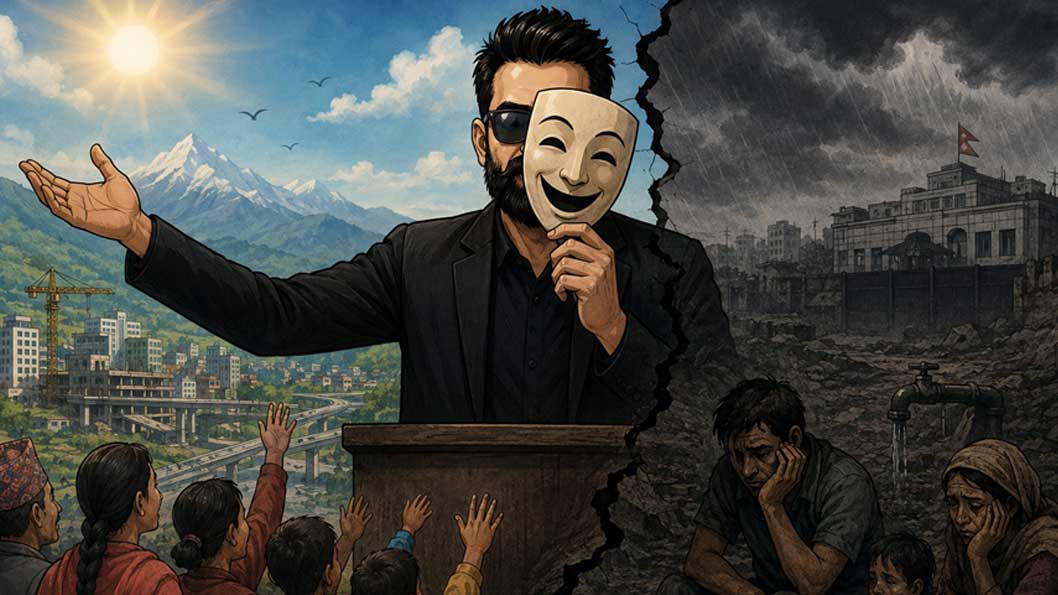
Governments do not lose public trust in a single day, its lost through silence when people demand answers, through arrogance when criticism deserves humility, and through the dangerous illusion that electoral victory alone guarantees political legitimacy. Nepal appears to be entering precisely such a moment.
The government led by the Rastriya Swatantra Party came to power promising a break from the old political culture. It spoke the language of accountability, transparency, and a new political ethic, riding a movement that had already paid in blood where at least 77 people died in the September 2025 uprising that brought down the old order. People were willing to give this new force the benefit of the doubt because they wanted politics to become genuinely different. Yet, governing a country is fundamentally different from campaigning against one, and the gap is starting to show in ways that are no longer abstract.
Take the last week of July. Communal violence tore through Sunsari and spread into Dhanusha and Siraha, leaving three dead and dozens injured, with authorities forced to impose indefinite curfews across Inaruwa, Janakpur, Siraha, Golbazaar, and Lahan. And the Prime Minister’s response to a province in flames? He waited five days before addressing the nation, and even then, read gravely off a teleprompter, expressing sorrow and calling for calm. Five days of silence is not caution. It is an absence, and absences get filled with rumor, with grief curdling into rage, with the sense that the highest office in the country simply was not paying attention when it mattered most.
This is not a personality flaw so much as a governing philosophy. A Prime Minister who also insists on personally holding the Home Ministry portfolio has concentrated crisis response entirely in one office and then left that office quiet exactly when the country needed to hear from it. People were sure about the restoration of PM’s favorite person.
Nowhere is this arrogance more visible, or more costly, than in how the government has treated Kathmandu’s poorest residents. Behind every riverside settlement lies a complicated story of migration, poverty, and decades of failed housing policy. These communities did not emerge overnight, nor can they be erased overnight yet that is essentially what was attempted.
In the early hours of April 25, bulldozers moved into the Bagmati settlements, and the campaign expanded through May into Balkhu and Sankhamul, under the cover of Nepal Police, the Armed Police Force, and municipal police. Families were given as little as three days to vacate homes built over years. Even a Buddhist monastery in Balkhu was flattened, despite requests from monastery authorities to spare it until after Buddha Jayanti. This was not an isolated administrative decision and it was the same instinct the Prime Minister showed as mayor, when he repeatedly tried to evict squatters through force and was criticized for bypassing consultation and due process. Power did not temper that instinct. It gave it a national police force to carry it out.
What makes this sting more than ordinary policy failure is the broken promise underneath it. The RSP’s own chair, Rabi Lamichhane, had told voters he would stand in front of the bulldozers himself rather than let squatters be removed. Months later, families evicted in April were still being shuffled between flooded holding centers, with no functioning resettlement plan in place nearly three months after the demolitions began. No one disputes that rivers need protecting and public land needs managing. But a government elected on the promise of compassion cannot simply swap old confrontation for a faster, more efficient version of the same confrontation and call it reform.
Across the Madhesh, there is always narratives of communal clash every year and the leaders shape it for the political leverage. That is not background noise in a country adjusting to new leadership. That is an accelerating trend, and it maps neatly onto a security culture that keeps arriving too late and too heavy-handed, in Sunsari, warning shots and tear gas failed to disperse a crowd before police resorted to live rounds, killing a man in his thirties. When accusations circulate that security forces sided with one community over another, the state is no longer managing a law-and-order problem. It is feeding the very polarization it claims to be containing.
And beneath the street-level violence sits a quieter, more calculated pressure. Hindutva-aligned groups have reportedly been in constant negotiation with the home minister, pushing for a return to a Hindu state, timed deliberately alongside ongoing constitutional amendment talks. This is happening in a country where rival parties openly campaigned in 2026 on platforms to restore the monarchy, reinstate a Hindu state, and scrap federalism altogether. They lost the election. But they do not need to win an election if a government distracted by bulldozers and delayed statements lets the Madhesh burn just often enough to make secularism and federalism look like the problem rather than the achievement. To silence these speculations, the PM publicly said that Nepal’s constitution won’t need any changes for next 50 years.
Democratic institutions do not collapse overnight. They erode when citizens gradually lose faith that power will respond to them fairly, quickly, and honestly. Nepal’s new government still has the standing to change course, to speak within hours instead of days, to negotiate resettlement before deploying excavators, to treat the Madhesh’s grief as a political emergency rather than a scheduling inconvenience. The slogan of “new politics” was never really about new faces. It was about retiring old habits: arrogance, opacity, and distance from the people who put you there. If those habits survive under this leadership too, then only the vocabulary of reform has changed, not its substance. That would not just be one government’s failure. It would be a betrayal of everyone who bled for the chance to try something different.
CP Aryal, has a PhD in Sociology. He teaches at Kathmandu University, School of Arts, Nepal.