
Imagine a very big casino. Millions of people have been invited to play the game. Everyone receives the same rules. Everyone is told that if they play well, they will win. The game appears fair because everyone enters through the same door and, at the end, everyone leaves with a result. Some players, of course, have prepared for years. They have people around them who already know the tips and tricks of the game. There are others arriving with whatever they have managed to put together. The casino can still declare its winners according to its own rules, and technically, nobody can say it cheated. I have found myself returning to this image when I think about competitive examinations in India. Merit on one hand provides the language of the game and the All India Rank (AIR) is its currency. The rank decides who gets the college seat, who gets the government job, and, beyond either of these, what kind of future one could imagine. I am sure this analogy could be a lazy comparison. Calling it a game of chance can easily erase the sheer amount of labour that goes into it. There’re coaching fees involved, family savings that get quietly used up, years where everything is planned around one exam day. A student who studies for ten or twelve hours a day is not gambling in any ordinary sense of the word. But I keep coming back to it anyway. It is the closest thing I have to naming the problem. Enormous amounts of effort go into a contest where the rewards are scarce and the conditions are already uneven. And when the examination itself turns out to be rigged, the promise of merit begins to look even harder to sustain. The trouble, I think, is less that aspirants are playing a game of luck than that they have been asked to believe that hard work alone decides who wins.
The unmasking of merit as ideology is by now a familiar move in the literature. From Willis’s (1977) account of how working-class boys are prepared, almost willingly, for working-class jobs, to Subramanian’s (2019) work on engineering institute where she shows merit itself is casteist in nature, scholars have shown how the language of merit can conceal the social conditions that make particular forms of achievement possible. Much of this work also carries the enormous debt of the field to Bourdieu’s writing on capital (Bourdieu 1986). I do not want to re-enter that thesis here. Enough has been said about it, though many things could emerge if empirically tested against the particular textures of Indian competitive examinations. I want instead to stay with the recent youth protest and place the competitive examination at the centre of the analysis. In the recent past, as a Phd student working on this topic and even before, I have been kept coming back, almost helplessly, to this question: why do so many people continue to apply for so few seats?
The Examination as a Social World
A lot has already been said about the recent protests in Delhi, and much more will follow. Some of it will be judgement, some political commentary, some just description. With time, the protest will probably settle into an event on a timeline, something that can be explained through familiar categories and labels. Right now, I find it difficult to name it or draw any settled meaning from it.
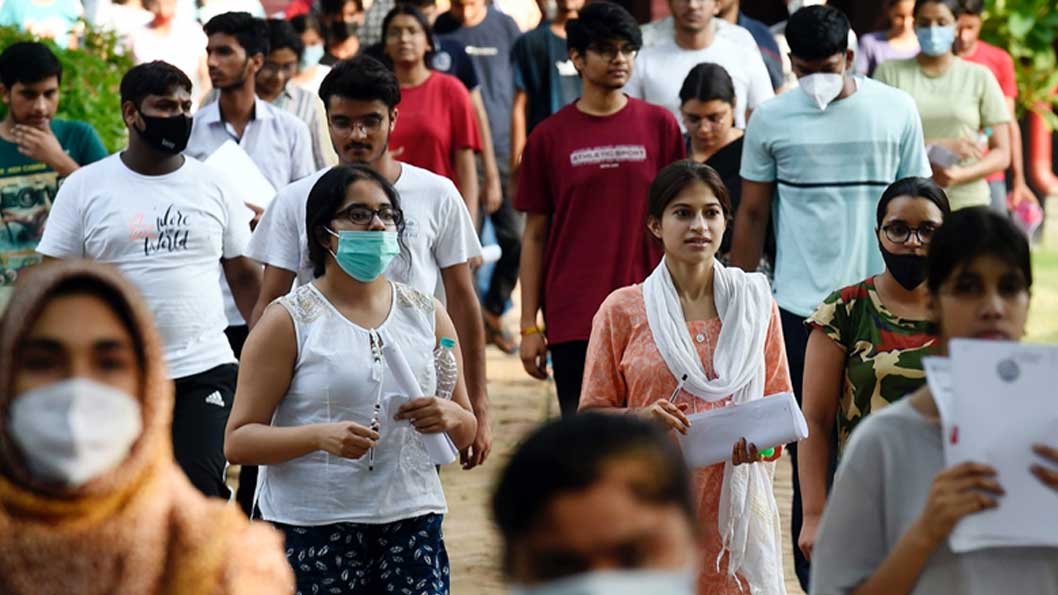
What I can say is that the crisis around competitive examinations in India is hardly new. It has been building for a long time. The recent protests may have been the moment when that pressure finally broke through, unexpectedly, though certainly not without a history. A wall had been cracking for years. Those who gathered in the protest did not seem to share one political ideology. What they did share, I think, was a cause: the feeling that an examination meant to provide a fair route towards education and social mobility had gone wrong somewhere. There were attempts to place the protest within familiar labels, left wing, anti-national, GenZ and more recently “dimagi naxal”. Yet these labels did not quite hold. The language of the protest evokes the larger crisis happening around the educational institutions in India and the anxiety produced by an examination system that has become part of everyday life. The Cockroach protest, placed along with the wider protests of unemployed youth across India, including those in Jharkhand, there are few things that became quite apparent initially. At least at first, it was difficult for the state to perform its usual work of othering the protesters by giving them a fixed identity. Who were they? Could they be placed within a religious category and turned into targets, as political discourse in India has learned to do so effectively? They were, instead, young people who had spent years inside what one might call the kiln of competitive examinations. That makes the protest uncomfortable for the state to handle, in a different way. It becomes harder to disown the people who are, in the most ordinary political rhetorics, supposed to be the nation’s future. This is also why I keep returning to the competitive examination as a sociological object. India has built an enormous social world around JEE, NEET, UPSC, SSC, banking, railway recruitment, state services, and countless other examinations. An aspirant’s day can be organised around study hours, mock tests, revision and doubt sessions. If we gaze over the everyday life of these aspirations, different temporalities begin to emerge. The year divides itself into attempts, while life takes on a vocabulary of ranks, scores, cut offs and chances. “I have two attempts left” is a small sentence, but it carries an entire idea of the future within it. And still, so many continue to place their faith
Affective attachments to competitive examinations in India have parallels in other parts of the world, especially with the Gaokao in China and the Suneung in South Korea. Howlett’s (2021) ethnography on the Gaokao beautifully treats the examination as more than an instrument of selection. He brings a schoolteacher’s account in one of his chapters who claims that without the Gaokao, a social revolution would have happened in China. I am not sure the claim needs to be taken literally. However, it reveals that examinations have become institutions that give social aspiration a direction. They basically tell millions of young people when to study, when to wait, when to try again, and when to finally accept whatever result they get.
I wonder what the equivalent question would be for India. More than 50 million young people are drawn into a world that sits somewhere between formal education and employment. They are aspirants. What they do is taiyari, or preparation. But taiyari can become an event in itself, a way of life shaped by waiting, discipline, repetition, postponement and hope. One attempt passes, then another, and the present begins to feel provisional, as if it will properly begin only when the result will be out. What would even happen if these exams just disappeared one day? Where do the millions who wake up each morning with an examination as their horizon would place their aspirations? Where would their waiting go?
The question becomes harder when placed against India’s larger political economy and the language of Aatmanirbhar Bharat. Banerjee (2026) reads this as a reworking of an older Nehruvian idea of self-sufficiency, one that became harder to reconcile with India’s later place in the global service economy. India became good at providing services around technologies developed elsewhere, while its own capacity to build them remained limited. AI makes this tension sharper. The competition now concerns the technology itself, from models and computing systems to chips and research. If AI unsettles the service economy that has absorbed much of India’s educated workforce, the problem extends beyond particular jobs. It raises a larger question about the kind of economy India is trying to build and what Aatmanirbhar Bharat can mean in such a moment.
The contradiction comes into sharper view through competitive examinations. They occupy the space between education and employment and, in doing so, absorb years of time. The aspirant can remain suspended there for a remarkably long period. The examination offers a few scarce opportunities, but it also delays the moment when people have to face how few those opportunities really are. This makes competitive examinations more than a mechanism of selection. They have become one of the places where the state manages, however uneasily, the gap between the aspirations produced by education and the opportunities available through work.
The emergence of the aspirant pressure group
Why can the government no longer take such a protest lightly? Part of the answer may lie in the social world that competitive examinations have produced. What we see now is not only a collection of candidates from different examinations. There is a pressure group that has begun to emerge from this milieu, even if it does not yet see itself clearly as one. Its members may prepare for different exams, come from different regions, and hope for very different jobs. Yet they increasingly inhabit the same world of preparation, uncertainty, waiting and repeated disappointment.
This world has also changed with the rise of digital media. Long before COVID-19, teachers in Kota had something close to celebrity status. Their faces appeared on billboards.Aspirants followed them from one institute to another. Coaching centres competed for star faculty. During my fieldwork, the early 2010s aspirants’ accounts described some of them as the rockstars of the coaching economy. Their fame, however, had limits. A popular teacher in Kota could still be almost unknown in cities like Lucknow or Patna.
Things changed during the pandemic when the coaching system moved online with remarkable speed. A teacher could now enter a village or a hostel room thousands of kilometres away through a phone screen. Figures like Khan Sir, Alakh Pandey, Vikas Divyakriti and Avadh Ojha became important within this new educational landscape as they started representing a different form of educational authority. The teacher is no longer tied to a classroom or even to a particular city. He can become a personality, a brand and even sometimes a political voice. Apart from the educational contents, the onus began to fall on them for motivating the youth and they sometimes started making political commentary. A larger population among the aspirants follow them, a phenomenon that becomes more apparent during the clash between the teachers or the coaching institutes. The teacher becomes part of the aspirant’s wider social world. And thus, a different kind of aspirant politics emerges out of it. In contrast to the older forms of student politics where things were often organised around the campus, aspirant politics has a different centre. It is organised around the examination and the uncertainty that surrounds it. We have seen earlier protests around NEET, SSC and railway recruitment. Tamil Nadu’s protests against NEET in 2016 raised concerns about the disadvantages faced by students from rural and state board backgrounds. SSC aspirants protested in Delhi in 2018 over irregularities and a paper leak. Railway recruitment protests in Bihar and elsewhere became much larger in 2022. For a long time, these protests could be treated as separate matters. SSC candidates were protesting ssc, neet students for the medical examinations. However, now I argue different examinations are beginning to produce a shared affective world.
The paradox!
Now when prime minister Narendra Modi announces from the Red Fort that the government will provide free coaching to the students, there is something strange about the state’s own entry into this market. On one level, this can be understood as an attempt to correct the inequalities of private coaching. Yet I don’t find myself convinced with this argument. Why does the state need to coach candidates for its own supposedly neutral examinations? If specialised preparation is necessary to succeed, what exactly is the examination measuring? Knowledge alone? Or a candidate’s fluency in the culture of examination preparation? The amount of free material already available on YouTube makes this even more curious as preparation materials itself are no longer necessarily the scarce resource. An even more important question, perhaps, is whether the state itself has begun to lose faith in formal education. A whole separate piece could be written on this growing mistrust of the education system in India, and on the way the purpose of education has gradually narrowed. Education increasingly appears to be valued for where it can place a student: in a job, a professional course, or an elite institution. Other purposes of education seem to have been pushed further to the margins. These exams offer the state a way to sort a large aspirational population without knowing individuals directly. The rise of entrance tests reveals this distrust of existing educational institutions. CUET-UG, introduced in 2022–23, was justified partly through differences in school boards and marking systems. It was like if Class XII results cannot reliably establish equivalence, another test must locate the “real” merit beneath them. The National Testing Agency, established in 2017, works on this logic through centralised and standardised testing. And the failure of NTA examinations have culminated into a strong anger lately which is quite apparent in the recent protests happening throughout the country.
However, the question of whether education has become reduced to producing workers for the labour market remains open. When education is valued only for getting a job, I think the casino analogy makes some sense after all. And even for a while, if we believe that the whole purpose of education is to crack these examinations as it has become common sense lately, by entering the coaching market, the state addresses, if it genuinely does, the problem as one of preparation. The deeper problem remains outside the frame: how many secure futures are actually available for all those who have spent years preparing for them? I hope the protest pushes us to look beyond the question of whether the next examination is fair and ask what kind of future we are preparing so many young people for.
References
Banerjee, Dwaipayan. Computing in the Age of Decolonization: India’s Lost Technological Revolution. Princeton, NJ: Princeton University Press, 2026.
Bourdieu, Pierre. “The Forms of Capital.” In Handbook of Theory and Research for the Sociology of Education, edited by J. G. Richardson, 241–258. New York: Greenwood Press, 1986.
Howlett, Zachary M. Meritocracy and Its Discontents: Anxiety and the National College Entrance Exam in China. Ithaca, NY: Cornell University Press, 2021.
Howlett, Zachary M. “Gaokao Warriors: Diligent Struggle in China’s College Entrance Exam.” Anthropology & Education Quarterly 54, no. 1 (2023): 22–39.
Subramanian, Ajantha. The Caste of Merit: Engineering Education in India. Cambridge, MA: Harvard University Press, 2019.
Willis, Paul. Learning to Labour: How Working Class Kids Get Working Class Jobs. Farnborough: Saxon House, 1977.
Aditya Kumar Pandey is a PhD researcher in Sociology at Shiv Nadar University – India. His research explores merit, competition, aspiration, and the social and emotional worlds created by competitive examinations in India.